 BRENTWOODDENTAL & TMD
Published October 2026.
Key Takeaways
In the splint vs. Botox for TMJ decision, the splint usually comes first and Botox is the add-on, because a custom splint protects teeth and joint for a one-time fee while Botox only quiets overworked chewing muscles for three to four months and must be repeated.
- The diagnosis sets the order: muscle-driven pain (clenching, sore jaw muscles, tension headaches) is where Botox fits; a joint or disc problem needs load management first, and Botox cannot fix a displaced disc.
- Over one year, published figures put Botox at roughly $1,500 to $6,000 (three to four sessions at $500 to $1,500 each) versus a one-time custom splint fee of $300 to $1,000-plus, plus adjustment visits.
- Both are needed when muscle pain outlasts a well-adjusted splint or clenching is damaging the appliance.
- Botox is not FDA-approved for TMD and is usually out of pocket; splint coverage is inconsistent too.
If you are weighing a splint vs. Botox for TMJ, you have probably noticed that most pages on the subject are written by an office that sells one of them. The two treatments do different jobs. A custom occlusal splint (also called a stabilization splint or bite splint, and loosely a night guard) manages the load on your teeth and jaw joint. Botulinum toxin type A (Botox, also sold under brand names such as Dysport and Xeomin) lowers the activity of the chewing muscles for a few months. Which one comes first depends on where your pain is coming from, and some cases need both. This guide covers the order, the diagnosis that sets it, the situations that call for both, and a one-year cost comparison built from published figures rather than guesses, for patients in the Nashville area and anywhere else both options are on the table.
Splint vs. Botox for TMJ: Which Comes First?
For most temporomandibular disorder (TMD, often called TMJ) cases, a custom occlusal splint comes first and Botox is added only if muscle pain persists, because the splint is reversible, costs once, and protects every night it is worn, while Botox is off-label for TMD, wears off in three to four months, and treats only the muscle part of the problem.
Federal guidance sets that frame. The National Institute of Dental and Craniofacial Research (NIDCR) states that because evidence for many TMD treatments is limited, experts recommend conservative treatments and avoiding anything that permanently changes the jaw joints, teeth, or bite. NIDCR describes intraoral appliances as devices that fit over the teeth, protect them, may help with habit reversal such as clenching, and do not change the teeth or bite. The same NIDCR page places botulinum toxin in its section on more complex procedures, notes that the FDA has approved it for conditions such as migraine but not for TMDs, and says results in TMD studies have been mixed. A reversible appliance tried first costs you nothing in future options. An off-label injection tried first skips the step that tells you what you are treating.
Muscle Pain vs. Joint Pain: The Question That Sets the Order
NIDCR groups TMDs into three broad categories: disorders of the joint itself, including disc disorders; disorders of the chewing muscles; and headaches associated with a TMD. NIDCR also notes that a person can have more than one of these at the same time. That classification is the whole decision in miniature, because a splint and Botox map onto different categories.
Muscle-dominant TMD looks like sore cheeks and temples in the morning, jaw fatigue after meals, tightness that gets worse under stress, and headaches that start at the temples. Botox works by relaxing muscles, according to NIDCR, and the Baylor College of Medicine describes the usual targets as the masseter (the thick muscle at the angle of the jaw) and sometimes the temporalis (the fan-shaped muscle at the temple). If the exam says the muscles are the problem, Botox has a job to do. Even then, the appliance usually comes first or alongside, because it protects the teeth from the clenching that made the muscles sore, it is reversible, and it costs once.
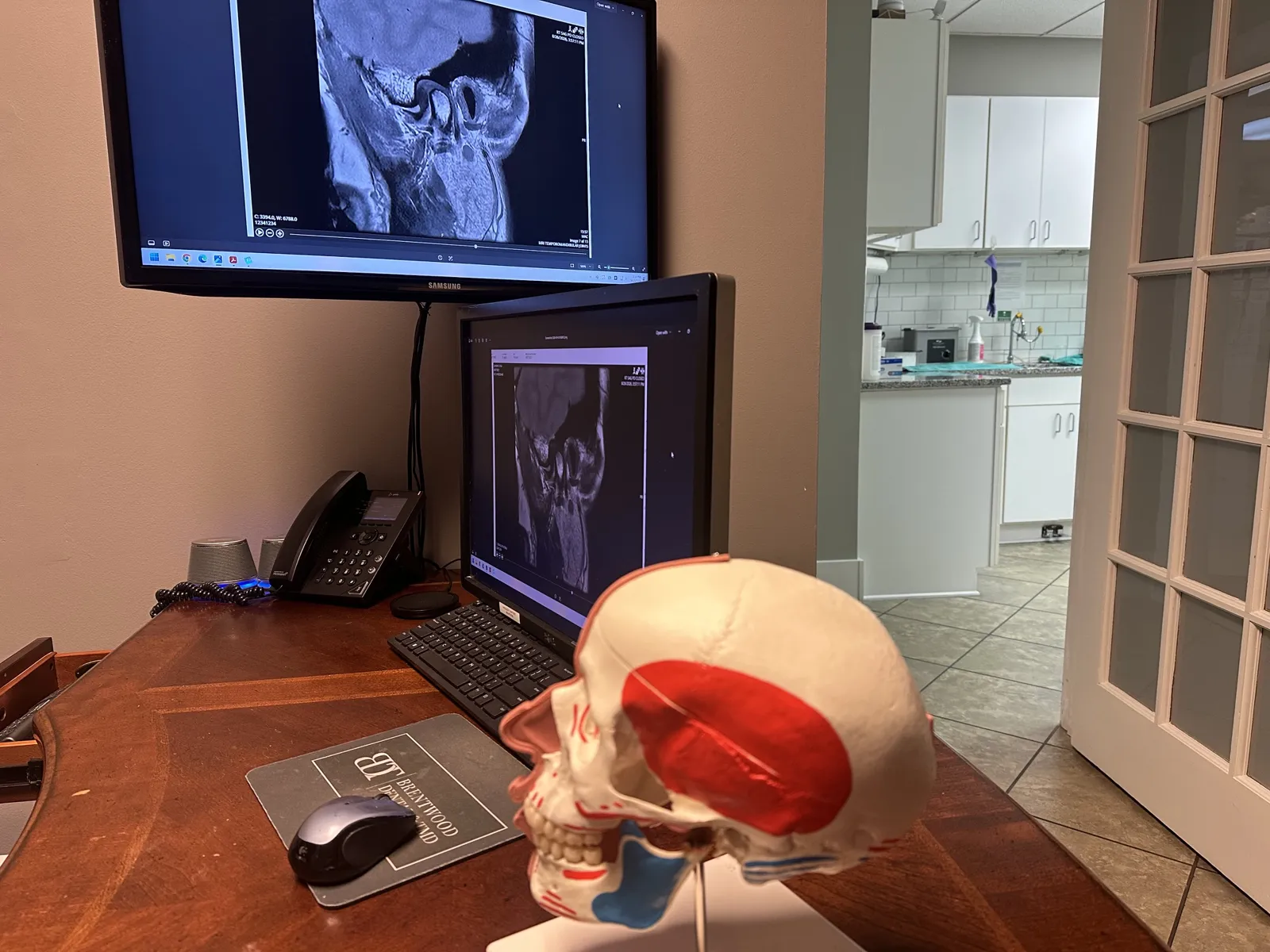
Joint-dominant TMD looks different: painful clicking or grating, a jaw that catches or locks, limited opening, or a bite that suddenly feels off. Those are the symptoms NIDCR lists as possible signs of a joint problem rather than a muscle problem. Botox has no mechanism for repositioning a displaced disc or repairing a worn joint surface. For this group, load management with a flat-plane splint, self-care, and often imaging comes first; Mayo Clinic notes that magnetic resonance imaging (MRI) is the test used to show problems with the joint’s disc and surrounding soft tissue. Botox enters later, if at all, when the muscles around the joint stay guarded after the joint itself has been addressed.
Sorting your case into one of those categories, or into both, is a clinical job, and the reasonable next step for anyone weighing a splint vs. Botox for TMJ is an evaluation with a dentist who makes that exact call daily and offers both treatments under one roof, so the recommendation is not shaped by which one the office sells. That is the approach at Brentwood Dental & TMD in Brentwood, TN (Nashville area), where roughly 95% of the caseload is TMD and complex restorative work, Dennis M. Holmes, DMD provides both custom splint therapy and therapeutic BOTOX, and the practice’s own BOTOX page states that Botox should not be given before a TMJ diagnosis is established or used as a primary treatment, because most patients have an underlying joint problem that needs attention first.
What Does a Custom TMJ Splint Do That Botox Cannot?
A custom occlusal splint spreads bite forces across a flat, stable acrylic surface, protects the teeth from grinding damage every night it is worn, and gives sore muscles a surface to rest against, all for a one-time fee; Botox does none of those physical jobs.
The TMJ Association describes a splint as a removable appliance, usually made of hard acrylic in a dental lab from an impression of your teeth, that the dentist fits and then readjusts over a series of follow-up appointments. The association describes the flat-plane version as intended to reduce tooth grinding and relax sore jaw muscles. That adjustment sequence is the part of splint therapy most patients underestimate, and it is the reason a therapeutic splint fee runs higher than a simple guard fee. What a custom splint fee actually covers, and how a flat-plane stabilization splint differs from a repositioning orthotic, is covered in the custom TMJ splint cost guide, so this article treats the splint as the reversible flat-plane appliance unless noted otherwise.
A splint has honest limits, and you should hear them before comparing it to anything. NIDCR says there is not a lot of evidence on whether intraoral appliances improve TMD pain, and Mayo Clinic states that the reasons these devices help are not well understood. CareCredit adds the point that matters most for this comparison: a guard does not stop you from clenching, it puts a cushion of protection between your teeth. The TMJ Association goes further, noting that a flat-plane splint does not prevent clenching because the lower teeth can still contact it, and that in some patients the splint can aggravate the condition. So a splint manages where the force goes. It does not turn the force down. Turning the force down is the one thing Botox does.
What Does Botox Do for TMJ That a Splint Cannot?
Botox lowers the activity of the masseter and temporalis muscles themselves for about three to four months, which no appliance can do; it does not protect teeth, does not change how the joint is loaded, and does not last.
Baylor College of Medicine puts the duration at around three to four months, which is why most patients who continue treatment return three to four times a year, with some needing it more often at first and less often over time. Results begin within about three to seven days and reach full effect around two weeks after injection. Baylor is also direct about what the injection does not do: it does not cure a TMD, it manages pain and muscle tightness. Healthline describes the evidence as encouraging but thin, citing a 2012 study of 26 people in which pain decreased and jaw movement improved for three months after treatment, and notes that researchers still call for more studies. Mayo Clinic lists botulinum toxin injections into the chewing muscles among the procedures considered when other methods have not helped, and introduces that option with the word “rarely.”
Side effects are mostly mild and temporary but worth knowing. Healthline lists headache, flu-like symptoms, nausea, temporary eyelid droop, and in some people a “fixed” smile lasting six to eight weeks. Baylor adds changes in chewing strength, mild asymmetry, and, in rare cases where the masseter is weakened a great deal, a loss of support along the jawline. The practical takeaway is that Botox is a muscle tool for a muscle problem. If your TMD is in the joint, it is the wrong tool. If your TMD is in the muscles, it is a temporary one that works best alongside something that handles the load.
| Splint vs. Botox at a glance | Custom occlusal splint | Botox (botulinum toxin type A) |
|---|---|---|
| What it does | Spreads bite force across a flat surface, protects teeth from grinding damage, gives sore muscles a surface to rest against | Lowers the activity of the masseter and sometimes temporalis muscles |
| What it does not do | Does not stop clenching (CareCredit, TMJ Association) | Does not protect teeth or change how the joint is loaded |
| Best fit | Joint or disc problems, grinding damage, load management | Muscle-dominant pain, clenching headaches |
| How long it works | Every night it is worn, until the appliance wears out | About 3 to 4 months per session (Baylor College of Medicine) |
| Reversible? | Yes, when designed as a flat-plane appliance that does not change the bite (NIDCR) | Effects temporary; off-label for TMD (NIDCR) |
| Evidence for TMD pain | Limited (NIDCR) | Mixed; unclear (NIDCR) |
| Cost pattern | One-time fee plus adjustment visits | Recurring, 3 to 4 times a year |
Botox or Night Guard for Clenching: Which Is Better for Bruxism?
For clenching and grinding (bruxism, the clinical term for both), a dentist-made guard or splint is the better first purchase because it physically protects the teeth every night at a one-time cost, and Botox becomes worth discussing when the clenching is strong enough to cause muscle pain or to chew through the appliance.
People searching for Botox or night guard for clenching usually mean a custom occlusal splint rather than a drugstore guard, and the difference matters. CareCredit’s breakdown puts custom guards made by a dentist at $300 to $500 on average, with some dentists charging $1,000 or more, and notes that stock drugstore guards are bulky, poorly fitted, and in some cases lead to more grinding rather than less. The TMJ Association cautions that over-the-counter splints are hard to fit precisely and can move teeth. For a clencher, the appliance also has to survive: CareCredit notes that hard materials are the most durable and that soft guards are not a long-term answer for regular grinders.
Botox has a real role in bruxism, with the same limits already described. Baylor College of Medicine lists reduced teeth grinding and fewer clenching headaches among the effects of relaxing the masseter, and Healthline lists headaches due to teeth grinding among the symptoms Botox may ease. NIDCR’s position still applies: it remains unclear whether the treatment relieves TMD symptoms. CareCredit also makes the cost point in one line, noting that even a custom guard from a dentist is less expensive than other bruxism treatments such as Botox. The sensible order for most grinders is guard first, Botox if the muscles stay sore or the guard keeps breaking, and never Botox alone, because the day the injection wears off, a guard is the only one of the two still protecting your enamel.
When Do You Need Both a Splint and Botox?
You need both when the muscle part and the load part of your TMD are both active: muscle pain that persists after a properly adjusted splint, clenching heavy enough to crack or wear through appliances, or a joint problem with a headache component layered on top.
Two authoritative sources make room for combined care. NIDCR notes that a person may have one or more TMD conditions at the same time, which means a joint disorder and a muscle disorder can coexist in the same jaw. Mayo Clinic states that when symptoms do not go away, a healthcare professional may recommend more than one treatment to be done at the same time. In practice, combined cases tend to follow one of three patterns.
The first pattern is the patient who has worn a well-made flat-plane splint for a few months, whose teeth are now protected and whose joint is quieter, but who still wakes with sore temples and tight cheeks. The load is handled; the muscle habit is not. Adding Botox to the masseter and temporalis while keeping the splint addresses the part the appliance could not reach.
The second pattern is the heavy clencher who has cracked or worn through more than one guard. Here Botox brings the force down so the appliance survives and the muscles get a rest, and the splint stays in the plan because the protection is still needed and the injection wears off in a few months.
The third pattern is the joint patient, often with a disc problem confirmed on imaging, whose surrounding muscles stay guarded and painful even after the joint itself has been managed. For this group, Botox comes last and only after the joint plan is in place.
Having treated more than 12,000 TMJ and TMD cases, Dr. Holmes points out that the order inside a combined plan is rarely a coin flip. “Botox quiets the muscle. It does not tell me why the muscle was working that hard,” says Dennis M. Holmes, DMD at Brentwood Dental & TMD in Brentwood, TN. “If the disc is displaced or the joint is being overloaded, I can relax the masseter every three months for years and the problem underneath never changes. In the cases that need both, the splint is doing the long-term work and the injection is buying the muscle a rest while it does. That is why the diagnosis has to come before the syringe.”
Splint vs. Botox for TMJ: How Do the Costs Compare Over One Year?
Over one year, published figures put Botox for TMJ at roughly $1,500 to $6,000, and higher at providers above the reported range, against a one-time custom splint fee that CareCredit puts at $300 to $500 on average and sometimes above $1,000, plus adjustment visits that have no published price.
Every number in that sentence traces to a named source, and each has a limit you should know. The per-session Botox figure comes from Healthline, which reports that treatment could cost $500 to $1,500 or more according to one medical provider, and which notes that the number of injections, the severity of symptoms, and your location all move the price. The frequency comes from Baylor College of Medicine’s three to four sessions per year, and Healthline separately says to expect at least three sessions over several months. The splint figures come from CareCredit’s custom guard range and from the TMJ Association, which states that full splint therapy, with its initial and follow-up appointments and fittings, can cost thousands of dollars. None of these are Brentwood Dental & TMD fees; any practice’s own fees are a phone call away.
| One-year cost comparison | Custom occlusal splint | Botox for the jaw muscles |
|---|---|---|
| What the fee covers | Exam, impressions or scan, lab-made appliance, and adjustment visits | Injections into the masseter and sometimes the temporalis, billed per session |
| Published per-item figure | $300 to $500 average, some $1,000+ (CareCredit); full splint therapy can reach thousands (TMJ Association) | $500 to $1,500 or more per session, per one provider (Healthline) |
| How often in year one | Once, plus follow-up adjustment visits (no published fee) | Every 3 to 4 months, about 3 to 4 sessions (Baylor College of Medicine) |
| Year-one total from published inputs | $300 to $1,000+ for the appliance, plus adjustment visits; thousands for a full diagnostic splint program | $1,500 to $6,000+ (3 sessions x $500 up to 4 sessions x $1,500) |
| Year two and beyond | Usually no new appliance; check-ups as needed; replace when worn | Same recurring cost if treatment continues; some patients need it less often over time (Baylor) |
| Insurance | Often not covered by medical or dental plans (TMJ Association) | Usually not covered; off-label for TMD (Healthline) |
| FDA status | Appliance should not permanently change the bite (NIDCR) | Approved for migraine, not for TMD (NIDCR) |
Figures are published national ranges, not Brentwood Dental & TMD fees. Year-one Botox totals are the per-session range multiplied by the session frequency; both inputs are cited in the text above.
How the One-Year Math Works
The Botox line is a multiplication problem: three sessions at $500 is $1,500, and four sessions at $1,500 is $6,000, so a year of Botox for TMJ at the prices Healthline reports lands between those two figures, and above them at providers charging more. The splint line is a one-time purchase plus visits: the appliance fee is paid once, the adjustment visits in the first months are the variable, and a hard acrylic appliance, which CareCredit describes as the most durable type, is not rebought on a schedule. Baylor’s note that some patients need Botox less often over time can pull the Botox line down in later years, and the TMJ Association’s warning that full splint programs can run into the thousands can pull the splint line up, so the honest summary is a range on both sides, with the recurring one sitting well above the one-time one. For the bigger picture of what moves TMD costs up or down, the TMJ treatment cost guide covers diagnosis, reversibility, and restorative add-ons in detail.
Does Insurance Cover a TMJ Splint or Botox in Tennessee?
Usually not for Botox, because it is off-label for TMD, and inconsistently for a splint, so plan on paying for Botox out of pocket and ask for a pre-treatment estimate before a splint is made.
Healthline advises calling your insurer but warns that coverage is unlikely because the FDA has not approved Botox for this use. The TMJ Association reports that because scientific evidence for splint safety and effectiveness is limited, neither medical nor dental insurance may cover splint therapy, and it recommends checking with your carrier in advance. The medical-versus-dental billing question, the role of documentation and imaging in getting a claim approved, and what to do after a denial are all covered in the TMJ treatment insurance guide. When coverage falls short, financing spreads the cost without changing it; Brentwood Dental & TMD offers CareCredit financing with approved credit.
What Should You Ask Before Choosing a Splint, Botox, or Both?
Ask which part of your TMD each treatment targets, muscle or joint, what happens when it wears off or stops helping, how many visits or sessions the quote covers, and what the total comes to over a full year rather than per item.
For the splint, the TMJ Association’s list of questions does most of the work: is this appliance meant to relieve pain and relax my muscles, or to reposition my bite; will I be able to stop wearing it once symptoms improve; how many follow-up visits are included and what does each cost; and what are the next steps if it does not help. For Botox, add four more: which muscles will be injected and why those; how often will I need to return; what is the plan at month three when it wears off; and what, besides the injection, is handling the load on my teeth and joint in the meantime. NIDCR’s general advice applies to both: ask about simpler treatments first, ask how the procedure helps your specific TMD and what the risks are, and get a second opinion before anything that cannot be undone. An office that answers all of those without hesitation has thought about your case. One that leads with a syringe or a lab slip before explaining your diagnosis has not.
Get the Order Right Before You Pay for Either
If jaw pain, clenching, or headaches have you deciding between a splint and Botox, start with the diagnosis that tells you which one you need and in what order. Call Brentwood Dental & TMD, Nashville’s Center for TMJ Treatment & Complex Dentistry, at (615) 371-8888 to schedule a consultation, and bring any appliance you already own; it is useful evidence.
Frequently Asked Questions
Is Botox or a splint better for TMJ?
Neither is better in general, because they do different jobs. A custom occlusal splint manages the load on your teeth and jaw joint and is a one-time cost, while Botox lowers chewing-muscle activity for about three to four months and must be repeated. For most people the splint comes first, and Botox is added only if muscle pain persists after the appliance has been adjusted.
Should I get Botox before or after a night guard for TMJ?
After, in most cases. A guard or splint protects your teeth from clenching damage and is reversible, so it is the sensible first step while your diagnosis is confirmed. Botox is not FDA-approved for TMD and wears off in a few months, so it works best as an add-on for muscle pain that a well-fitted appliance has not resolved.
How long does Botox last for TMJ?
About three to four months, according to Baylor College of Medicine, which is why most patients who continue treatment return three to four times a year. Results usually begin within three to seven days and reach full effect around two weeks after the injection. Some people need it more often at first and less often over time.
How much does Botox for TMJ cost per year?
Roughly $1,500 to $6,000 a year based on published figures, and more at some providers. Healthline reports a per-session cost of $500 to $1,500 or more according to one provider, and Baylor College of Medicine reports three to four sessions a year, so the yearly total is that per-session price multiplied by three or four. Insurance usually does not cover it because the use is off-label.
Can you wear a night guard after Botox for TMJ?
Yes, and in combined treatment plans that is the normal arrangement. Botox reduces how hard the chewing muscles work, while the guard or splint protects the teeth and manages the load on the joint, and the two jobs do not conflict. Keeping the appliance also matters because the injection wears off after a few months and the appliance keeps protecting your teeth after it does.
Does Botox help TMJ if the problem is the joint, not the muscles?
Generally no. Botox works by relaxing muscles, so it addresses muscle-driven TMD symptoms such as clenching pain and tension headaches. It has no mechanism for repositioning a displaced disc or repairing a worn joint surface, which is why joint-dominant cases with painful clicking, locking, or a changed bite are managed with load control and imaging first.
Is Botox for TMJ covered by insurance?
Usually not. The FDA has approved Botox for conditions such as chronic migraine but not for TMD, so most insurers treat the use as off-label and decline coverage. Healthline suggests calling your insurer anyway in case your plan is an exception, and planning to pay out of pocket if it is not.
Can Botox replace a night guard for teeth grinding?
No, not safely. Botox can reduce the force of clenching and grinding for a few months, but it does not put any barrier between your teeth, and once it wears off your enamel is unprotected. A custom guard or splint protects the teeth every night it is worn, which is why a guard or splint usually stays in the plan even when Botox is added.