 BRENTWOODDENTAL & TMD
Published July 2026.
Key Takeaways
There is no standard price for TMJ treatment in Nashville, and the cost depends largely on how far care extends beyond the diagnostic stage, with published figures ranging from several hundred dollars to hundreds of thousands of dollars.
- The TMJ Association states plainly that no standardized costs exist for TMJ treatments, and that prices vary by provider and by state.
- Diagnosis is the biggest variable, because the National Institute of Dental and Craniofacial Research reports there is no widely accepted standard test for these disorders, and the term covers more than 30 separate conditions.
- Evidence for many TMD treatments is thin. Federal sources report limited evidence that intraoral appliances relieve TMD pain, and no evidence supporting occlusal treatments that permanently change the bite.
- Insurance frequently excludes or limits TMD coverage, so your out-of-pocket exposure is often the number that actually matters.
If you are asking how much does TMJ treatment cost in Nashville, you have probably already discovered that nobody will give you a straight number. That is frustrating, and it is also, unfortunately, the honest state of things. This article explains why the number is hard to pin down, what actually drives it up or down, what the research says about which treatments are worth paying for, and the questions that get you a real quote instead of a vague one.
Looking for the treatment itself rather than prices? Our TMJ and TMD treatment page explains how Dr. Holmes diagnoses and treats jaw pain at our Brentwood office.
How Much Does TMJ Treatment Cost in Nashville?
There is no standard price, and any site quoting you a single figure is guessing. The TMJ Association, a patient advocacy nonprofit that the National Institute of Dental and Craniofacial Research links as a resource, states directly that there are no standardized costs for TMJ treatments, that costs vary by provider and by state, and that treatment can run from several hundred dollars to hundreds of thousands of dollars.
That range sounds useless until you understand what it describes. The low end is a person with muscle soreness who improves with self-care and a single appliance. The high end is someone who moves through injections, joint procedures, surgery, and full-mouth restorative work over a period of years. Those are not the same condition and they are not the same bill. Your job as a patient is to figure out which end of that range your actual problem sits on before you start spending.
Why Is There No Standard Price for TMD Treatment?
Temporomandibular disorder (TMD, commonly called TMJ) is not one condition with one treatment, which is the root of the pricing problem. The National Institute of Dental and Craniofacial Research (NIDCR) describes TMDs as a group of more than 30 conditions affecting the jaw joint, the chewing muscles, and associated headaches, and it notes that there is no widely accepted standard test available to diagnose them.
No standard test means no standard workup, and no standard workup means no standard fee. Two people can walk into two Nashville-area offices with identical symptoms, receive two different diagnoses, and be quoted amounts that differ by a factor of ten. Neither dentist is necessarily wrong. They are working from different models of what is causing the pain.
The scale of the condition is worth knowing as context. NIDCR reports that roughly 11 to 12 million American adults have pain in the region of the temporomandibular joint, and that the condition is about twice as common in women as in men, especially in women between 35 and 44. Cleveland Clinic notes similar figures and adds that TMD most often starts between ages 20 and 40.
What Drives the Cost of TMJ Treatment Up or Down in Nashville?
Three factors move your total more than anything else: how much diagnostic work your case needs, whether treatment stays reversible, and whether restorative dentistry gets added on. Everything else is detail.
Diagnostic depth comes first. A clinical exam alone is inexpensive. Imaging adds cost, and NIDCR notes a dentist may suggest an x-ray, an MRI, or a CT scan depending on what the exam turns up. Whether you need imaging is a clinical judgment, not a given.
Reversibility is the second and largest fork in the road. Reversible care means appliances, physical therapy, medication, and self-management, none of which permanently change your teeth or jaw. Irreversible care means grinding down teeth, placing crowns, or moving teeth to change the bite. The second category costs multiples of the first, and as the next section covers, the evidence behind it is weak.
Added restorative work is the third factor and the one that produces the eye-watering totals. If years of grinding have worn or cracked teeth, repairing them is real dentistry with real value, but it is a separate expense from treating the joint disorder. Be clear with any provider about which part of a quote is TMD care and which part is restorative work, because they are different decisions with different justifications.

What Should You Expect to Pay For Before Any Treatment Starts?
Expect the first real expense to be a thorough evaluation, and expect it to be the most useful money you spend. Given that NIDCR reports no standard diagnostic test exists and that patients with these disorders are often misdiagnosed or given treatment that does not help, the evaluation is the step that determines whether everything after it is money well spent or money repeated.
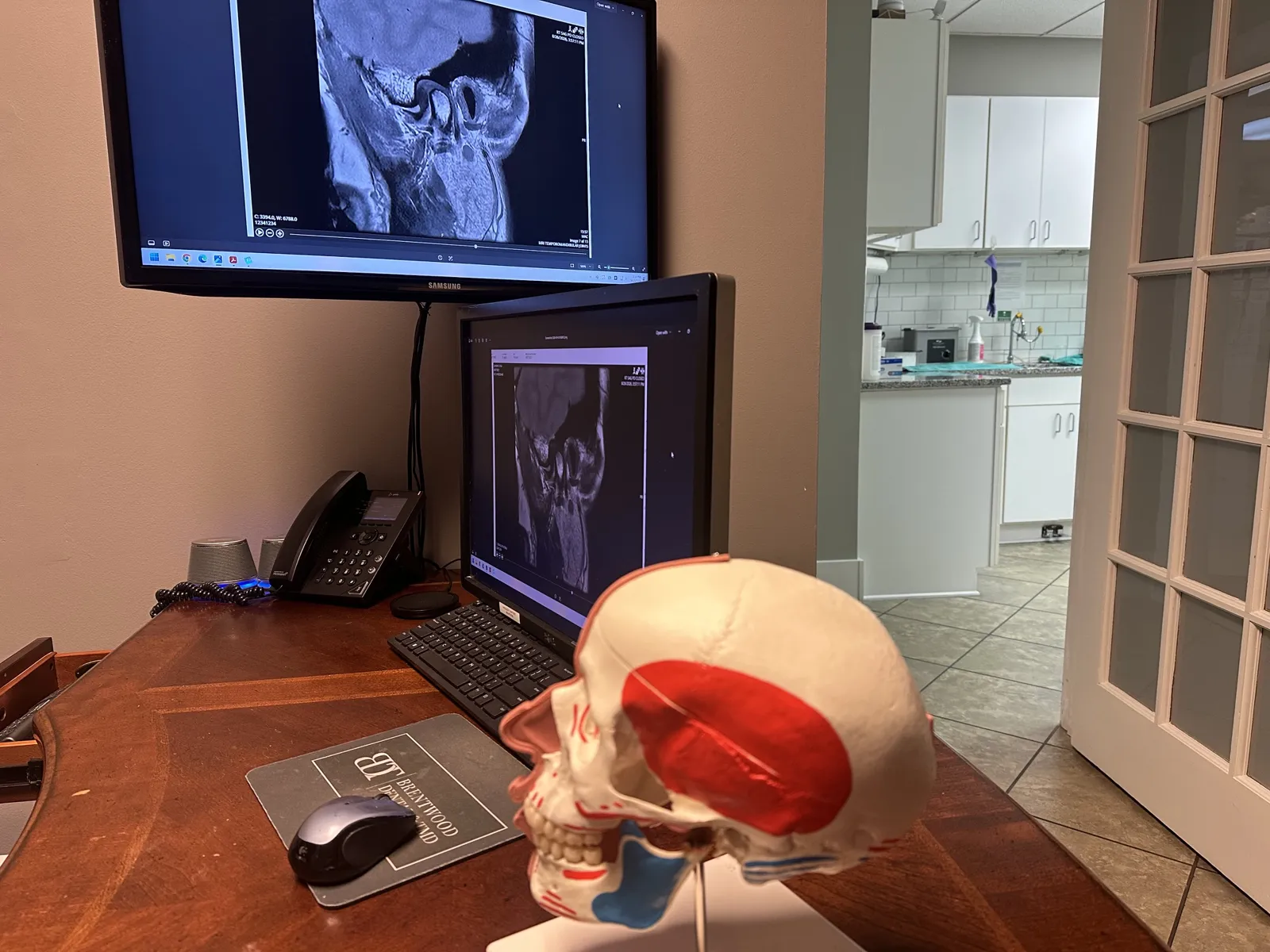
If your jaw pain has already outlasted one appliance from one office, the reasonable next step is an evaluation with a dentist who works in TMD daily rather than occasionally. In the Nashville area, that describes Brentwood Dental & TMD in Brentwood, TN (Nashville area), where roughly 95% of the caseload is TMD and complex restorative work rather than routine general dentistry. Dennis M. Holmes, DMD has ordered and interpreted more than 24,000 TMJ MRIs over 30-plus years of practice, and he is a Fellow of the Academy of General Dentistry who completes roughly 100 continuing education hours a year. You can review his training, credentials, and case history on his bio page.
Custom Occlusal Splint vs. Over-the-Counter Night Guard: What Is the Real Cost Difference?
The drugstore guard is far cheaper upfront, and the price difference reflects clinical time and adjustment rather than a difference in proven pain relief. This is the comparison most patients face first, so it is worth laying out honestly.
| Factor | Over-the-Counter Night Guard | Custom Occlusal Splint from a Dentist |
|---|---|---|
| Upfront cost | Lowest. Bought off a shelf or online. | Higher. Includes exam, impressions, lab work, and follow-up visits. |
| How it is made | Generic shape, or softened and bitten into at home. | Made from impressions or scans of your own teeth. |
| Adjustment over time | None. If it does not fit, you replace it. | Adjusted at follow-up appointments, which is much of the added cost. |
| Diagnosis included | No. You are self-treating an undiagnosed problem. | Yes, an exam precedes it, though the depth of workup varies by office. |
| Evidence for TMD pain relief | Limited, per NIDCR. | Also limited, per NIDCR. Cost difference is not an evidence difference. |
That last row is the one most articles leave out. Paying more does not purchase better published evidence. What it purchases is a device fitted to your mouth, adjusted over time, and prescribed after someone examined you. NIDCR does add one specific caution worth heeding regardless of which you choose: make sure any appliance is not designed to permanently change your bite, and stop using it and consult your dentist if it causes pain.
What Does the Research Say About Paying for TMD Treatments?
Federal sources urge caution about several treatments that are commonly sold as TMD care, and you should know this before you sign a treatment plan. NIDCR states that there is not a lot of evidence that intraoral appliances improve TMD pain. On occlusal treatments, a category it defines as including placing crowns, grinding down teeth, and orthodontic movement, NIDCR states there is no evidence these treatments work and that they could make the problem worse. On botulinum toxin, NIDCR notes it is FDA-approved for conditions such as migraine but not for TMDs, and that it is unclear whether it relieves TMD symptoms.
An Agency for Healthcare Research and Quality topic brief summarizing a 2020 National Academies report reaches a similar conclusion, noting that despite considerable research into occlusal adjustment and equilibration, these treatments have not been found effective, and that data are inadequate or of poor quality for most TMD treatments. That same brief notes guidance is consistent in recommending reversible, conservative approaches first.
None of this means you should refuse all treatment. It means the burden is on any provider to explain why your specific diagnosis justifies a specific intervention, and it means treatments that permanently change your teeth deserve a second opinion before you pay for them. NIDCR says exactly that: ask about simpler treatments first, ask how the procedure helps your specific disorder, ask about risks, and get second opinions.
Does Insurance Cover TMJ Treatment Cost in Brentwood, TN?
Often not, or only partially, and that gap is usually the largest single factor in what you personally pay. The TMJ Association reports that insurance reimbursement for TMJ treatment is complex, that coverage varies by state, company, and policy, and that some policies carry specific exclusion clauses while others cap the dollar amount or restrict coverage to surgical procedures.
The association is candid about the reason. It notes that insurers generally exclude TMJ coverage unless required to include it, because there is controversy about the causes and proper treatment of the condition and little scientific evidence demonstrating that therapies are safe and effective. Reasonable or not, that is the environment you are buying in.
Practically, this means two things. Ask any office to submit a pre-determination to your carrier before treatment starts, so you learn what is covered before you owe it rather than after. And ask whether financing is available. Brentwood Dental & TMD, for example, offers financing through CareCredit with approved credit, which spreads cost without changing it.
How Do You Avoid Paying for TMJ Treatment Twice?
Get the diagnosis settled before you buy the device, because the most common way patients overspend is by purchasing appliance after appliance without anyone establishing what is actually wrong. Each individual purchase looks reasonable. The total, after three of them, is not.
“The patients who end up spending the most are almost never the ones with the worst joints. They are the ones who bought treatment three times before anyone told them what they had. I have owned this practice for a long time, and I would rather spend an hour on a diagnosis and tell someone their problem is muscular and self-limiting than sell them an appliance they did not need.”
Dr. Holmes, owner of Brentwood Dental & TMD
There is a related point in the research that cuts the other way and is worth sitting with. NIDCR notes that signs and symptoms of TMD resolve in many people without any treatment at all, and that joint sounds without pain are common, normal, and do not need treating. If your jaw clicks but does not hurt, the cheapest correct answer may be no treatment. A provider who tells you that is saving you money, not losing your business.
What Questions Should You Ask Before Agreeing to a TMJ Treatment Plan?
Ask for your specific diagnosis in writing before you discuss any fee, because a quote without a named diagnosis is a price for an unknown product. Once you have it, five more questions will tell you most of what you need to know.
Ask which of the 30-plus temporomandibular disorders you have been diagnosed with, and what the exam or imaging showed that supports it. Ask whether the proposed treatment is reversible or permanent. Ask what the plan is if the first phase does not help, and whether that next phase costs more. Ask for the total anticipated cost of the full course of care rather than a per-item price, since TMD care is usually a sequence rather than a single purchase. Ask what happens to the cost if treatment runs longer than expected.
An office that answers all five without hesitation is an office that has thought about your case. One that cannot answer the first is one you should be cautious with, whatever the quoted price.
If jaw pain, headaches, or a bite that never feels settled has you weighing yet another appliance, start with a diagnosis instead of a device. Call Brentwood Dental & TMD, Nashville’s Center for TMJ Treatment & Complex Dentistry, at (615) 371-8888, or request a consultation online. You can also read more about how the practice approaches TMJ and TMD therapy