 BRENTWOODDENTAL & TMD

At a Glance
- Service: Specialist evaluation and treatment of TMJ / TMD: jaw joint disorders, bite problems, and chronic headaches
- Serving: Franklin and Williamson County, a 9-mile / ~15-minute drive south of the Brentwood office via US-31 or I-65
- Office hours: Monday–Thursday, 7:00 a.m.–4:00 p.m.
- Accepting new patients: Yes
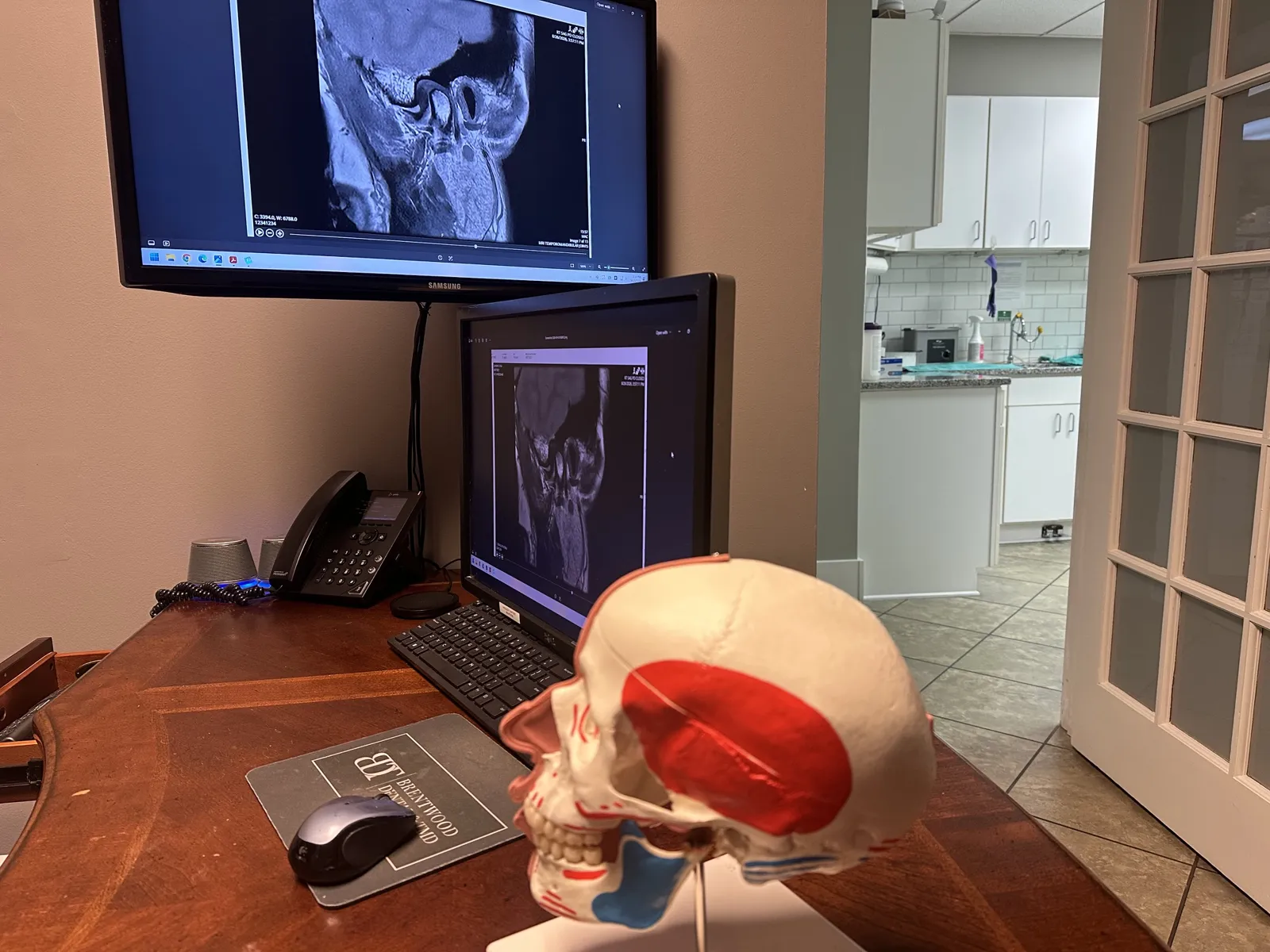
- Key differentiator: Dr. Holmes has ordered and interpreted over 24,000 TMJ MRIs, building diagnoses on imaging rather than guesswork

Not every jaw ache needs a specialist, and a good one will tell you so. The question worth answering first: is your problem the kind a general dentist's night guard can settle, or the kind that needs someone who treats jaw joints all day? Here is how to tell which camp you are in before you make the drive from Franklin.
You are likely a candidate if
You should see a TMJ specialist if your jaw joints click, pop, or grind, if your jaw locks or sticks open or closed, or if you have no comfortable place to rest your jaw. The same is true if your bite suddenly feels off, if your teeth show abnormal wear, or if you get recurring headaches, ear pressure, or facial pain that no one has connected to your jaw. A joint that pops without pain still counts, because these disorders progress when left alone.
You are an especially good fit if you have already tried a generic bite splint that did nothing. Franklin patients land here often for exactly that reason. A universal splint treats an average jaw, not yours, and when it fails the problem was usually a missing diagnosis, not a hopeless case.
When a specialist may not be the answer
Some headaches are true vascular migraines with no jaw component, and some ear or neck pain originates in the ear or the cervical spine rather than the joint. An honest specialist runs the tests to find out instead of assuming the jaw is guilty. Dr. Holmes has specific tests to identify the true source of pain, and if your jaw is not the cause, he will say so and point you in the right direction.
What the joint disorder actually is
The temporomandibular joint sits in front of each ear where your lower jaw meets your skull, and it lets you talk, chew, and yawn. Disc displacement, an uneven bite, arthritis, injury, or muscle fatigue from clenching and grinding can all disrupt it. Because the pain often spreads into the head, face, and neck, the broader term TMD describes it more accurately than TMJ alone.

Meet Your Doctor: Dr. Dennis M. Holmes

The reason a Franklin patient drives nine miles for a diagnosis comes down to imaging volume. Dr. Holmes has ordered and interpreted more than 24,000 TMJ MRIs over his career, which lets him read a joint with a precision that comes only from seeing that many. He has treated over 12,000 TMD patients across 30+ years, building each appliance around an accurate diagnosis rather than a one-size mold. That is the difference between guessing and knowing, and it is why so many “I already tried a night guard” cases resolve here.
Getting Here From Franklin
Franklin sits just south of the office down US-31 (Franklin Road), a straight nine-mile shot that runs about fifteen minutes door to door. If you prefer the interstate, I-65 north works just as well and can be quicker at peak times; exit toward Brentwood and head to Virginia Way. From the west side of town near Westhaven, Mack Hatcher Parkway to I-65 north is the cleaner route than cutting through the historic district.
Because the office opens at 7:00 a.m., many Franklin patients schedule before work and beat the northbound I-65 commuter build-up entirely.
What to expect during and after your visit
Your first visit is diagnostic: history, a hands-on exam of the joint and muscles, and imaging. From there you get a plan matched to your specific diagnosis, often a custom splint designed for your joint rather than an off-the-shelf appliance. As the joint and muscles stabilize, the clicking, headaches, and jaw fatigue ease. Relief usually builds gradually rather than flipping on overnight, which is the honest expectation for a structural problem.
Franklin Patient Questions
I already tried a night guard from my Franklin dentist and it did not help. Is it worth driving up?
A: Yes, and that is one of the most common reasons Franklin patients come here. A generic guard often fails because no accurate diagnosis was made first. Dr. Holmes determines why your prior treatment did not work, then designs a custom appliance around your actual diagnosis.
How do I know if my headaches are from my jaw or something else?
A: Many headaches diagnosed as migraines are actually caused or worsened by a TMJ problem, though true vascular migraines do exist. Only proper testing tells them apart. Dr. Holmes has specific tests to find the true source before recommending any treatment.
My jaw clicks but does not really hurt. Should I still come in?
A: Yes. A painless click signals a joint that has shifted, and these problems tend to worsen over time rather than resolve on their own. Catching it early gives the best chance to stabilize the joint before it becomes painful or locks.
Is the drive from Franklin really only about fifteen minutes?
A: From central Franklin it is roughly nine miles up US-31, about fifteen minutes in normal traffic, sometimes a little more if you take I-65. Early appointments starting at 7:00 a.m. help you avoid the heavier northbound commute.
Will I need braces to fix my TMJ problem?
A: Sometimes orthodontics helps correct a bite, but it should never come before an accurate TMJ diagnosis. Starting braces on an unstable joint can make things worse. Dr. Holmes establishes the diagnosis first, then determines if orthodontics has any role.
Brentwood Dental & TMJ
5120 Virginia Way, Ste C13, Brentwood, TN 37027
(615) 371-8888
https://brentwooddentalandtmd.com/areas-we-serve/tmj-specialist-in-franklin-tn/