 BRENTWOODDENTAL & TMD
Published May 2026.

Key Takeaways
Most jaw pain causes fall into a handful of categories: temporomandibular joint disorders, teeth grinding or clenching (bruxism), dental problems, sinus issues, arthritis, and jaw injury.
- TMJ disorders affect 11 to 12 million American adults, and women are about twice as likely to develop them as men.
- More than 70 percent of dentists in a 2021 ADA Health Policy Institute survey reported seeing increases in patient teeth grinding and clenching, both common drivers of jaw pain.
- Jaw pain that lingers more than a week or two, locks the jaw, or radiates to the ear, head, or neck should be evaluated by a dentist trained in temporomandibular disorders.
- Accurate diagnosis usually requires a clinical exam plus imaging like dental X-rays or MRI before any irreversible treatment is started.
Jaw pain causes are often layered, with muscle tension, joint damage, dental problems, and stress overlapping in the same person at the same time. That's the central challenge: the jaw shares nerves and muscles with the ears, sinuses, neck, and teeth, so pain in one place rarely points cleanly to one source.
If you woke up with a sore jaw, hit a wall during chewing, or felt a pop when you yawned, you're already trying to figure out what's behind it. The temporomandibular joint (TMJ) is the joint just in front of each ear where your lower jaw meets your skull, and it does more work than almost any other joint in your body. It opens, closes, slides, and rotates every time you eat, speak, swallow, or yawn. When something in that system goes wrong, pain can show up in places that seem unrelated to the jaw itself, which is part of why so many people spend months bouncing between doctors before getting a real answer.
This article walks through the most common jaw pain causes in plain language, explains how a TMJ-focused dentist sorts them out, and tells you when it's time to stop self-treating and get evaluated.
What Are the Most Common Causes of Jaw Pain?
The most common jaw pain causes are temporomandibular joint disorders (TMDs), bruxism (teeth grinding or clenching), dental problems like cavities or abscesses, sinus infections, arthritis in the jaw joint, and jaw injury or trauma. Most patients have more than one of these going on at once.
According to the American Dental Association's MouthHealthy resource, jaw soreness can come from sinus problems, infections, arthritis, injuries, gum disease, and TMJ issues, and the right treatment depends on which one is really driving the pain. Here's what each of those looks like.
Temporomandibular joint disorders (TMDs, sometimes called TMJ)
Temporomandibular disorders are a group of more than 30 separate conditions affecting the jaw joint and the muscles that move it, according to the National Institute of Dental and Craniofacial Research. The NIDCR estimates that 11 to 12 million U.S. adults have pain in the TMJ region. Symptoms usually include jaw aching, pain in front of the ear, headaches, neck pain, and clicking, popping, or grating sounds when the mouth opens.
TMDs typically fall into one of two categories. Muscle-related (myogenic) TMD involves the chewing muscles and is the more common type, often tied to clenching or grinding. Joint-related (arthrogenous) TMD involves the joint itself, including a slipped or torn disc inside the joint, arthritis, or damage to the bony surfaces. A person can have both at the same time.
Bruxism (teeth grinding and clenching)
Bruxism is the habit of grinding teeth back and forth or clenching them together with force, often during sleep. The pressure puts steady strain on the jaw muscles and joints, which is why so many bruxers wake up with a tight, sore jaw or a dull headache. A 2021 American Dental Association Health Policy Institute survey found that over 70 percent of dentists were seeing increased grinding and clenching among patients, and more than 60 percent were also seeing increased TMJ symptoms, jaw pain, and headaches as a result.
Bruxism is often linked to stress, sleep disturbances, an uneven bite, and habits like nail biting, gum chewing, or cheek biting.
Dental problems
A cracked tooth, deep cavity, dental abscess, or failing crown can all refer pain into the jaw. Pain that gets worse with hot or cold, sweet foods, or biting pressure usually points to a tooth-related cause. Gum disease is another quieter source: as inflammation builds, the pain can spread along the jawbone and feel like a joint or muscle problem when the real issue is the gum and bone supporting a tooth.
Sinus problems
The maxillary sinuses sit directly above the upper back teeth, so when those sinuses are inflamed or infected, the pressure radiates downward and feels like jaw or tooth pain on the upper sides of the face. Sinus-driven jaw pain tends to come with congestion, post-nasal drip, and a pressure feeling that gets worse when you bend forward.
Arthritis in the jaw
Osteoarthritis and rheumatoid arthritis can both involve the TMJ. The Mayo Clinic lists arthritis as a leading risk factor for TMJ disorders, alongside jaw injury, connective tissue diseases, and habits like clenching or gum chewing. Jaw arthritis usually progresses slowly and tends to show up as stiffness in the morning, grating sounds when chewing, and pain that worsens with use.
Jaw injury or trauma
A blow to the jaw, a sports impact, a car accident with a sudden flexion of the neck, or even a difficult dental procedure can sprain ligaments, displace the joint disc, or fracture bone. Some injuries cause immediate, severe symptoms. Others sit quietly for months or years before the joint starts to break down and produce pain.
How Do TMJ Disorders Cause Jaw Pain?
TMJ jaw pain happens when the jaw joint disc shifts out of place, the joint surfaces wear down, or the muscles around the joint stay in a constant state of contraction. The result is pain in the joint, the muscles, or both, often with clicking, popping, or limited movement.
Inside each TMJ, a small cartilage disc sits between the rounded head of the lower jaw and the socket in the skull. That disc is held in place by ligaments. If those ligaments stretch or tear, even from a minor injury, the disc can slip forward. When you open your mouth, the disc may pop back into place with an audible click. When you close, it can slip out again. Over time, the joint can wear unevenly and the surrounding muscles compensate by working harder, which produces the steady ache most TMD patients describe.
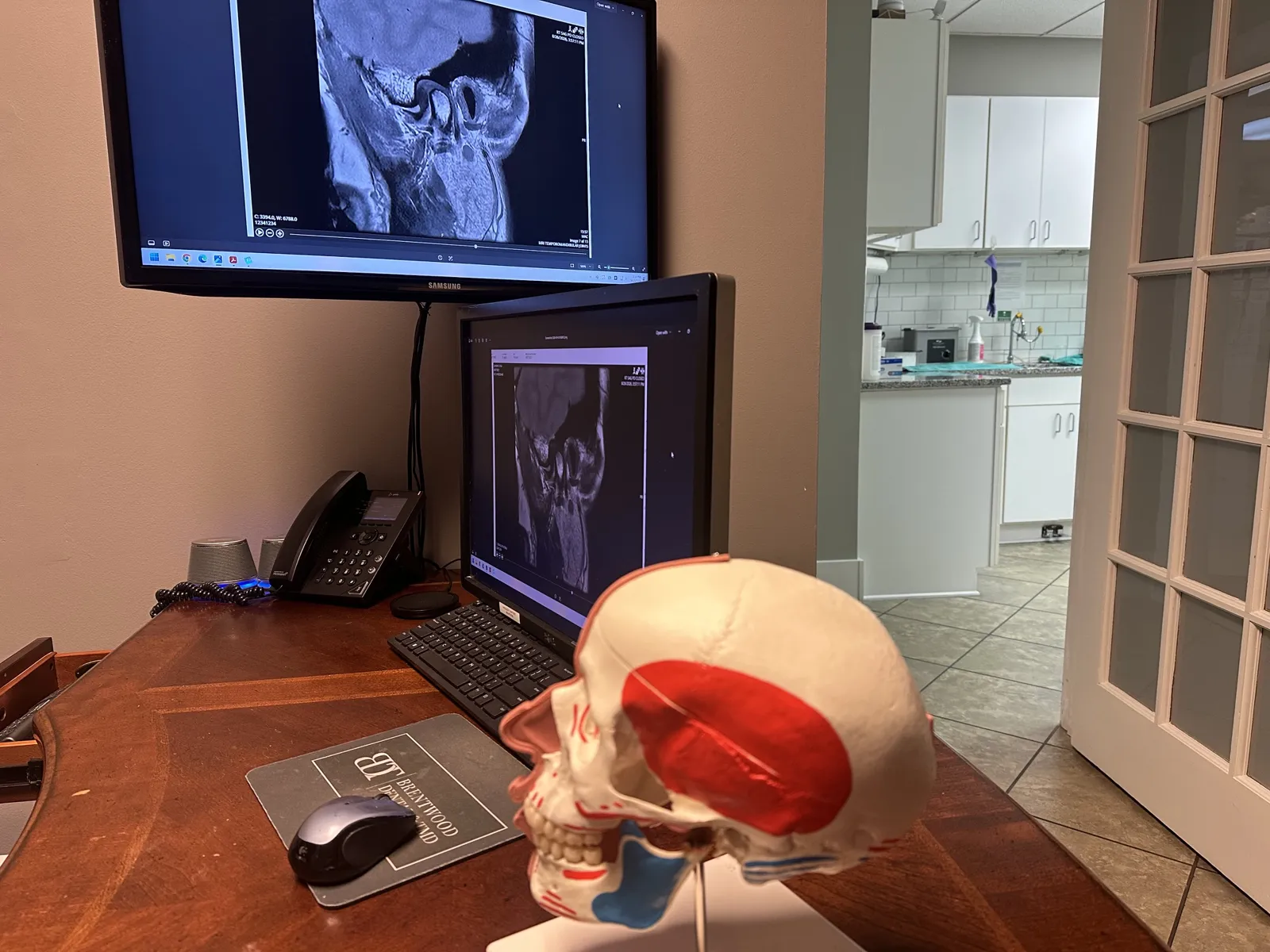
Dr. Holmes has personally ordered and interpreted more than 24,000 TMJ MRIs, which is what allows Brentwood Dental & TMD in Brentwood, TN (Nashville area) to distinguish a muscle-driven case from a disc displacement and choose the right treatment for each. The NIDCR's current guidance is to start with conservative options and avoid any procedure that permanently changes the teeth, bite, or joint until a thorough evaluation is complete.
"Patients often spend years cycling through migraine medications, ENT visits, and physical therapy before anyone looks at the jaw joint itself. In my experience, once you image the joint and identify what's actually happening structurally, the path forward usually becomes obvious. Most jaw pain has a physical explanation, and most patients can get real relief without surgery." — Dennis M. Holmes, DMD, Brentwood Dental & TMD in Brentwood, TN (Nashville area)
Could My Jaw Pain Be Caused by Teeth Grinding?
Yes, teeth grinding is one of the most common drivers of jaw pain, and most people who grind do not know they're doing it. The pressure from clenching during sleep or during stressful moments overloads the jaw muscles and joints, producing morning soreness, headaches, and ear pain that can mimic other conditions.
The American Dental Association notes that bruxism can produce dull headaches, sore facial muscles, tender jaw joints, and tooth sensitivity, and that most people only find out they're doing it when a dentist spots flattened or chipped tooth surfaces during an exam. Stress is the most discussed trigger, but sleep disorders, an uneven bite, missing or crooked teeth, and certain medications can all be involved.
Custom-fit occlusal splints (sometimes called night guards) are commonly used to protect the teeth and reduce muscle activity, but the NIDCR warns that splints designed without a specific diagnosis can fail to relieve symptoms. That's a key distinction. A generic over-the-counter night guard is not the same thing as a splint designed for a specific TMD diagnosis.
What's the Difference Between Muscle-Related and Joint-Related Jaw Pain?
Muscle-related jaw pain comes from overworked or strained chewing muscles, while joint-related jaw pain comes from problems inside the temporomandibular joint itself, such as a displaced disc or arthritis. The two can occur together, but they require different treatment approaches.
Here's how they typically compare.
Muscle-related (myogenic) jaw pain:
- Dull, aching pain spreads across the cheeks, temples, or sides of the head, often with no single clear location.
- Symptoms are worse in the morning if grinding or clenching happens at night, and ease somewhat as the day goes on.
- Often improves with rest, heat or cold packs, and stress reduction techniques.
- Frequently linked to bruxism, prolonged stress, posture problems, or an uneven bite.
- Usually managed with conservative care like custom splints, physical therapy, and behavioral changes.
Joint-related (arthrogenous) jaw pain:
- Sharper pain localized in front of the ear, often with a clear point of tenderness.
- Comes with clicking, popping, locking, or grinding noises when the jaw opens or closes.
- Movement of the jaw, especially wide opening or chewing tough foods, makes it worse.
- Caused by disc displacement inside the joint, arthritis, trauma, or developmental issues.
- Diagnosis usually requires imaging like an MRI to see what's happening inside the joint.
Both types respond best to conservative care first. As the NIDCR puts it, evidence is lacking for many invasive TMD treatments, and procedures that permanently alter the teeth, bite, or joint should generally be avoided until conservative options have been tried.
Why Does My Jaw Hurt When I Open My Mouth?
Jaw pain when you open your mouth usually comes from the jaw joint itself: a disc that has slipped out of place, inflammation inside the joint, or tight chewing muscles that resist stretching. Where it hurts and whether it makes a sound both give useful clues.
- Pain with a click or pop. The cushioning disc inside the joint can slide forward and snap back into place as you open. The Cleveland Clinic describes this disc movement as a common cause of jaw clicking.
- Pain with no sound, and you can't open as wide as usual. The disc may no longer move back into place, a later stage the TMJ Association describes, or the chewing muscles may be in spasm.
- Pain that is worst when you wake up. This often points to clenching or grinding during sleep.
- Pain right in front of the ear when you yawn or take a big bite. This usually means the joint itself is irritated.
If your jaw gets stuck open or closed, or you suddenly can't bring your teeth together after a yawn or an injury, the Cleveland Clinic treats a dislocated jaw as a medical emergency. Go to urgent care or the ER.
For everything else, Dr. Holmes checks how far and how straight your jaw opens during the exam, and imaging shows whether the disc is where it should be.
What Causes Sudden Jaw Pain?
Sudden jaw pain most often comes from a tooth problem such as an abscess or cracked tooth, a night of hard clenching, a jaw injury, or a TMJ flare-up. In rare cases it is a warning sign of a heart attack, so the symptoms that come with the pain matter more than the pain itself.
Call 911 if sudden jaw pain comes with any of these. The American Heart Association lists them as heart attack warning signs: chest pain or pressure, shortness of breath, a cold sweat, nausea, lightheadedness, or pain in one or both arms, the back, or the neck. The AHA notes that women are more likely than men to have symptoms other than chest pain.
Without those symptoms, the pattern usually tells you where to start:
- Throbbing pain that gets worse with hot, cold, or biting usually means a tooth. The Cleveland Clinic notes that an abscess can send pain into the ear, jaw, or neck. See a dentist within a day or two, and the same day if you have swelling or a fever.
- Pain after a hit, a fall, or a big yawn can be a sprain, a dislocation, or a fracture. Get it checked the same day if your teeth don't close normally.
- Soreness after a stressful week or poor sleep is usually muscle overload from clenching.
Why Does My Jaw Still Hurt After a Week, or Keep Coming Back?
Jaw pain that lasts more than a week or two, or fades and returns, usually means the cause is still there. A sore jaw from one hard chew or one bad night of grinding tends to settle within days. Pain that keeps coming back points to an ongoing habit like clenching, a joint problem, or a tooth that is still infected.
The National Institute of Dental and Craniofacial Research says many TMDs last only a short time and go away on their own, but some become chronic. Jaw pain that comes in cycles, good for a few weeks and then bad again, is a common pattern with TMJ problems.
Start with the home care steps below for the first week. Book an evaluation if any of these apply:
- The pain has lasted more than two weeks or is getting worse.
- Clicking has turned into catching or locking.
- The pain has spread to your ear, temple, or neck.
- Episodes keep coming back month after month.
Recurring jaw pain is exactly what Brentwood Dental & TMD in Brentwood, TN focuses on. Dr. Holmes looks for the reason the pain keeps returning, not just a way to quiet the current flare-up.
Why Does My Chin Hurt?
Chin pain usually comes from the lower front teeth or the gums around them, sore muscles from clenching or grinding, or an injury. Numbness in the chin is a different problem and needs a prompt exam.
- Lower teeth and gums. An abscess or a deep cavity in a lower tooth can send pain into the chin and jaw, according to the Cleveland Clinic. Pain that changes when you bite or drink something cold points here.
- Clenching and grinding. The American Dental Association lists jaw pain and tenderness among the signs of teeth grinding. If your chin and jaw ache mostly in the morning, grinding during sleep is a likely cause.
- Injury. A fall or a blow to the chin can injure the jaw itself. The Cleveland Clinic lists trauma among the common causes of jaw pain.
If part of your chin or lower lip feels numb or tingly and there is no clear reason, such as recent dental work, see a dentist or doctor soon. The Journal of the American Dental Association describes numb chin syndrome as rare but often linked to serious disease, so it should not be brushed off.
When Should I See a Dentist for Jaw Pain in the Nashville Area?
You should see a dentist trained in temporomandibular disorders if your jaw pain lasts more than a week or two, locks your jaw open or closed, radiates to the ear or temple, or interferes with eating, speaking, or sleeping. Pain after a recent injury or with sudden onset deserves immediate attention.
The Cleveland Clinic recommends seeing a healthcare provider if jaw pain, clicking, or stiffness doesn't improve on its own. The Mayo Clinic adds that constant pain or tenderness, especially if you can't open or close your mouth fully, calls for prompt evaluation.
For patients in the Brentwood and Nashville area, this often means finding a dentist with deep training in TMD diagnosis specifically, not just a general dentist who occasionally treats jaw symptoms. Diagnosis is where most TMD cases go off the rails. Without imaging the joint and assessing the bite, splint, and posture together, treatment plans tend to chase symptoms rather than fix root causes. With more than 12,000 TMD cases treated, Brentwood Dental & TMD has organized its workflow around exactly that gap.
Brentwood Dental & TMD accepts referrals from general dentists, physicians, neurologists, and ENT specialists across the Nashville metro for patients whose jaw pain has not responded to standard care.
How Does a Dentist Diagnose the Cause of Jaw Pain?
A dentist diagnoses jaw pain through a detailed medical history, a hands-on exam of the jaw, teeth, and muscles, and imaging like dental X-rays, CT scans, or MRI. The goal is to separate dental causes from joint and muscle causes before any treatment begins.
A typical workup looks something like this:
- History of the pain, including when it started, what makes it better or worse, and any recent injuries or dental work.
- A physical exam to check jaw range of motion, joint sounds, muscle tenderness, and bite alignment.
- Dental X-rays to look for cavities, abscesses, cracked teeth, or bone loss.
- Advanced imaging if joint damage is suspected. MRI is the gold standard for evaluating the soft tissue inside the joint, including the disc.
- Review of medical conditions, medications, sleep patterns, and stress factors that may be contributing.
This step matters because the NIDCR specifically warns against irreversible treatments before a proper diagnosis is established. Crowns, equilibration, orthodontics, or surgery performed without an accurate picture of what's happening inside the joint can worsen the underlying problem.
What Treatments Are Available for Jaw Pain?
Most jaw pain responds to conservative, reversible treatments, including custom splints, physical therapy, jaw exercises, behavioral changes, and short-term anti-inflammatory medication. More involved cases may benefit from therapeutic injections or, in a small subset of patients, surgical care.
The treatment categories most commonly used today include:
- Custom occlusal splints designed for the specific diagnosis, not generic store-bought guards.
- Physical therapy and targeted jaw exercises that help stretch tight muscles and stabilize jaw movement.
- Stress management, cognitive behavioral therapy, and biofeedback, which the NIDCR recognizes as effective for many TMD patients.
- Anti-inflammatory medication and short courses of muscle relaxants for symptom relief during active flare-ups.
- Therapeutic BOTOX (botulinum toxin) injections for chronic muscle-driven head and jaw pain that hasn't responded to first-line care. Brentwood Dental & TMD offers therapeutic BOTOX in these specific cases, but only after a TMD diagnosis is confirmed.
- Restorative or cosmetic dental work to correct worn, broken, or improperly fitting teeth that are driving an uneven bite.
- Arthrocentesis or arthroscopy for select cases of joint damage where conservative care has not relieved symptoms.
- Open joint surgery, reserved for severe cases where every other option has failed.
The American Academy of Orofacial Pain, which became the 12th officially recognized dental specialty in 2020, supports evidence-based, conservative-first care for the majority of jaw pain cases.
What Should I Do Right Now if My Jaw Hurts?
If your jaw hurts right now, start with conservative steps: switch to soft foods, apply heat or cold to the area, take an over-the-counter anti-inflammatory like ibuprofen if appropriate for you, avoid wide yawning or gum chewing, and watch your posture. If symptoms don't ease within a week or two, book an evaluation.
The NIDCR's plain-language recommendation is to start with simple measures, see a dentist or doctor if symptoms persist, and avoid any treatment that makes permanent changes to your jaw, bite, or teeth without solid evidence behind it. That's the safest first move for almost every patient.
Ready to Find Out What's Actually Causing Your Jaw Pain?
If your jaw pain has lasted more than a couple of weeks, is keeping you up at night, or has bounced around without a clear answer, Brentwood Dental & TMD can help. Positioned as Nashville's Center for TMJ Treatment and Complex Dentistry, Brentwood Dental & TMD has built its diagnostic process around exactly the kinds of jaw pain cases that get missed elsewhere. Call (615) 371-8888 to schedule a consultation with Dr. Dennis M. Holmes, or request an appointment online.