 BRENTWOODDENTAL & TMD
Published August 2026.
Key Takeaways
In the TMJ specialist vs general dentist decision, your general dentist is the right first stop for jaw pain, but jaw locking, painful clicking, a failed night guard, or a recurring headache pattern calls for a dentist whose practice is dedicated to TMD.
- “TMJ specialist” is not a regulated title, so verify a provider’s TMD case volume, use of joint imaging, and diagnostic approach instead of relying on the label.
- Temporomandibular disorders (TMDs) include more than 30 distinct conditions, according to the National Institute of Dental and Craniofacial Research, so accurate diagnosis matters more than any single treatment.
- Painless clicking alone is considered normal and does not need treatment.
- Reversible, conservative care should come before any treatment that permanently changes the teeth, bite, or joint.
If you have jaw pain and a dentist you already trust, the TMJ specialist vs general dentist question comes down to one thing: matching the severity of your problem to the depth of experience treating it. Your general dentist is the right starting point for many jaw complaints, and for a meaningful share of patients, that is also where the problem gets resolved. But temporomandibular disorders (TMDs, often called TMJ) cover a wide range of conditions, and some of them need a level of diagnostic depth that a general practice treating TMD occasionally is not built to provide. This guide explains what each type of provider does well, the specific signs that your jaw problem has outgrown first-line care, and, for the dentists reading, why referring a complex TMD case out is good dentistry.
Can My Regular Dentist Treat TMJ?
Yes, your regular dentist can treat many common TMJ problems, and it is usually a good place to start. General dentists can check for dental causes of jaw pain, like a cracked tooth or abscess, help you with habits such as clenching or chewing gum, and fit a night guard if you grind your teeth.
This matches what the National Institute of Dental and Craniofacial Research (NIDCR) says. Many TMDs are short-term and get better on their own. Simple steps like eating soft foods, using heat or cold, taking over-the-counter anti-inflammatories, and changing habits can help, and your dentist can guide you through these. The NIDCR also points out that clicking or popping in the jaw joint without pain is common and does not need treatment.
The main limit of general dental care for TMJ is diagnosis. TMDs include over 30 different conditions, such as joint, disc, and muscle disorders, as well as headaches. There is no single test to identify which one you have. A dentist who only sees a few TMD cases each year may not recognize all the patterns, and a treatment that works for muscle problems might not help with joint issues.
Should You See a Doctor or a Dentist for TMJ?
For most jaw pain, see a dentist first. TMJ disorders involve the jaw joint, the chewing muscles, and the way your teeth meet, and a dentist can check all three while ruling out a cracked tooth or abscess in the same visit. NIDCR advises consulting a dentist or doctor and starting with simple, reversible care, so whoever you see first, ask for that conservative approach.
See a physician first if jaw pain comes with chest pain or shortness of breath (call 911), a fever with facial swelling, or numbness in the face. Sudden, electric shock pain in the face that comes in brief bursts can point to trigeminal neuralgia, a nerve condition that a neurologist treats, not a dentist. If you are weighing a neurologist against a TMJ dentist, this guide shows which symptoms point where, and our jaw pain causes guide lists the warning signs that need emergency care.
What Is the Difference Between a TMJ Specialist and a General Dentist?
The real difference between a TMD-focused dentist and a general dentist is in their experience, diagnostic skills, and treatment options, not their title. A general dentist treats TMD along with other dental work like fillings and cleanings. A TMD-focused dentist specializes in jaw joint disorders, so their first appointment and follow-up care are different, especially if basic treatments have not worked.
| General dentist | TMD-focused dentist | |
|---|---|---|
| Share of practice devoted to TMD | Small, alongside routine care | Most or nearly all of the caseload |
| Typical first step | Exam, habit coaching, standard night guard | Joint-specific exam plus imaging before treatment |
| Diagnostic imaging | Dental X-rays | MRI and 3D imaging of the joint itself when indicated |
| TMD case volume | A few cases per year | Hundreds per year across many TMD types |
| When symptoms persist | Refers out or retries the same appliance | Reclassifies the diagnosis and adjusts the plan |
| Bite and joint changes | Rarely undertaken for TMD | Approached cautiously, after imaging confirms the cause |
One important difference is whether the dentist uses joint imaging. According to Mayo Clinic, causes of painful TMJ disorders include disc displacement, arthritis, joint injury, and muscle problems, and each needs a different treatment. To tell them apart, imaging the joint itself is usually needed, not just the teeth. A dentist who uses joint imaging before treatment is relying on evidence, which is more important than any title.
What Does “TMJ Specialist” Actually Mean?
“TMJ specialist” is a marketing phrase, not a regulated credential, so the term tells you very little on its own. The TMJ Association, a national patient advocacy organization, puts it plainly: there are no formally developed, consistent protocols of care for TMJ in dentistry or medicine, and a variety of providers advertise themselves as TMJ specialists while practicing under very different schools of thought. The American Dental Association recognized Orofacial Pain as a dental specialty in 2020, and board-certified orofacial pain specialists are one legitimate path for complex facial pain. But the number of such providers is small, and most TMD care in the United States is delivered by dentists with focused training and deep case experience rather than that specific board certification.
That means the burden shifts to you, the patient, to verify what the label cannot. Useful questions include: What share of your practice is TMD? How many cases have you treated? Do you image the joint before treating it? What happens if the first treatment does not work? These have checkable answers. In the Nashville area, Dennis M. Holmes, DMD publishes his on the practice bio page: TMD and complex restorative dentistry as the primary focus, advanced training at the Piper Clinic in St. Petersburg, Florida, and case counts a patient can ask about directly.
“After 30 years and thousands of these cases, the pattern I see most often is a patient who spent a long time treating the wrong problem,” says Dr. Holmes, owner of Brentwood Dental & TMD in Brentwood, TN (Nashville area). “The tagline on our website is ‘Experience the difference… of experience,’ and that is a deliberate statement. The title on the door matters less than whether the dentist can tell you exactly what is happening inside your joint before anything is done to your teeth. Experience is something a patient can ask about and check.”
How Do the Kinds of TMJ Providers in Tennessee Compare?
Dentists and orofacial pain specialists handle most TMJ diagnoses and nonsurgical care. Oral surgeons handle joint procedures. Physical therapists and physicians treat muscle problems and rule out other causes. The table below compares all six options.
| Provider type | Best for | Typical first step | Usually surgical? | Referral needed? |
|---|---|---|---|---|
| General dentist who focuses on TMD | Jaw pain, clenching, painful clicking, jaw-related headaches | Exam, bite and joint evaluation, imaging in some offices | No | Usually not |
| Board-certified orofacial pain specialist | Chronic, complex, or nerve-related facial pain; second opinions | Detailed pain history and exam | No | Usually not; check your plan |
| Oral and maxillofacial surgeon | Joint damage, locking or pain that has not responded to other care | Imaging review and surgical consult | Yes, procedures are the core role | Often |
| Dental school clinic | Lower-cost care for patients who can handle longer visits | Screening appointment | Depends on the clinic | Varies; call the clinic |
| Physical therapist | Muscle tightness, limited opening, jaw exercises | Movement and posture evaluation | No | Depends on your plan |
| ENT or neurologist | Ear symptoms, headaches, nerve pain | Medical exam to rule out other causes | No | Depends on your plan |
When Should You See a TMJ Specialist Instead of Your General Dentist?
You should see a TMD-focused dentist (often called a TMJ specialist) if your jaw locks or catches, if clicking is painful, if a night guard has not helped after a fair try, or if headaches keep coming back with jaw symptoms. These signs suggest the problem is in the joint or disc, not just a habit, and need a joint-level diagnosis.
Locking, catching, or limited opening
If your jaw locks open or closed, catches when you move it, or will not open fully, this usually means a disc or joint problem, not just muscle tension. Mayo Clinic says you should get care if you have constant jaw pain or tenderness, or if you cannot open or close your jaw all the way. Locking is the clearest sign that you need more than habit coaching or a standard night guard.
Painful clicking, popping, or grating
Painless clicking by itself is normal. However, if clicking is painful or you feel a grating sensation when moving your jaw, the disc inside the joint may have shifted or the joint surfaces may be wearing down. Telling the difference between a displaced disc and arthritis or another joint problem requires imaging, and this affects the treatment plan.
An appliance that did not help
A night guard that has been worn consistently for weeks without improvement is information, not failure. It suggests the first working theory, usually simple bruxism, was incomplete. Repeating the same appliance rarely changes the outcome. Reclassifying the diagnosis does.
Headaches that keep coming back with jaw symptoms
TMD-related headache is one of the NIDCR’s three broad TMD categories. When temple headaches, ear pressure, or facial pain travel together with jaw stiffness or noise, the headache pattern deserves a jaw-level workup rather than another round of pain medication.
If one or more of these escalation signs describes your jaw problem, the reasonable next step is an evaluation with a dentist who works in TMD daily rather than occasionally. In the Nashville area, that is what Brentwood Dental & TMD is built for: roughly 95% of the practice is dedicated to TMJ/TMD therapy, headache treatment, and complex restorative care, and Dr. Holmes has treated more than 12,000 TMD cases across his career. That caseload is the practical version of the escalation criteria above, because a practice seeing these problems every day has usually already seen a version of yours.
What Happens After a Referral for TMD Care?
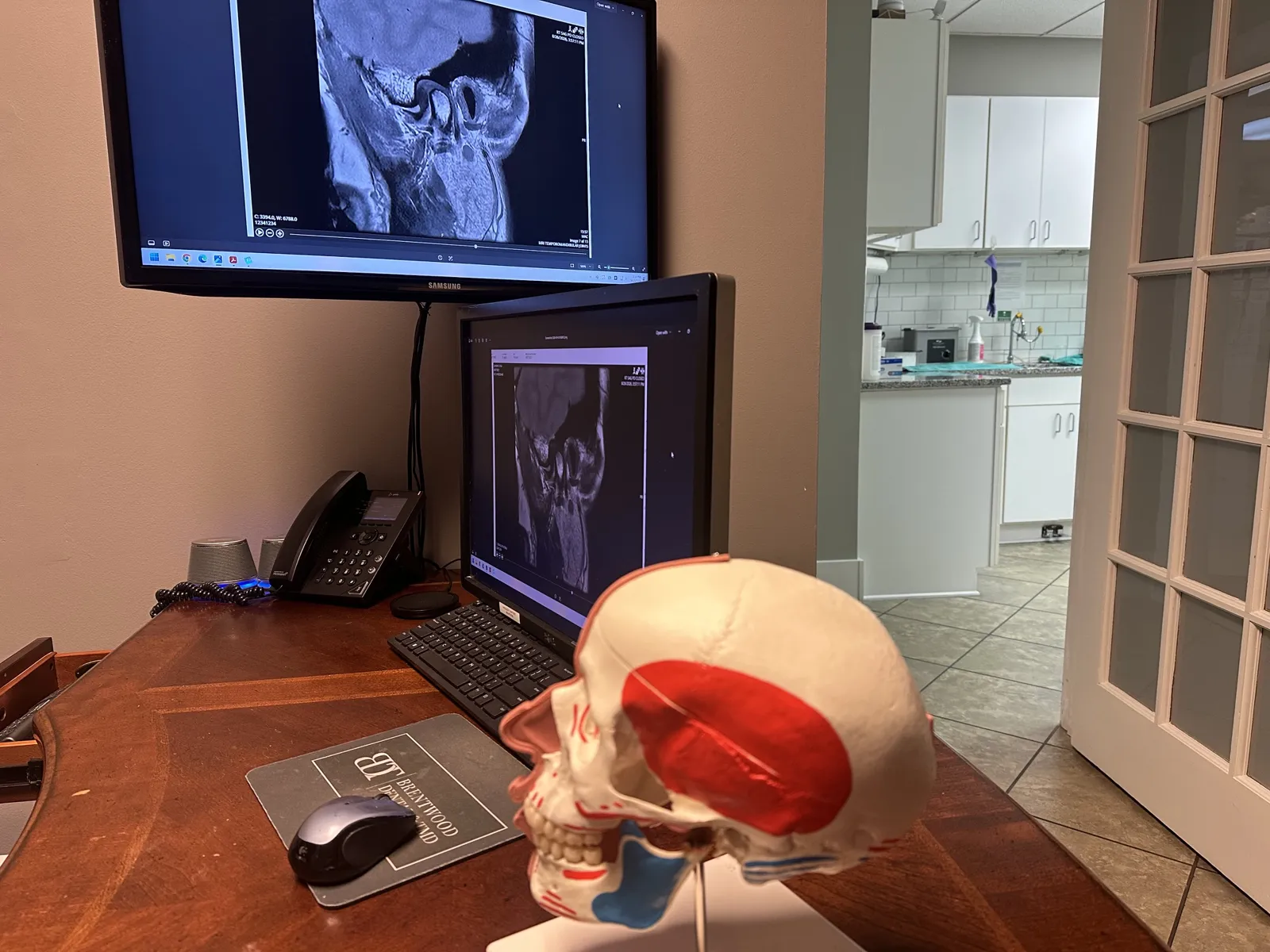
A referral to a TMD-focused practice starts with diagnosis, not treatment, and that ordering is the point. The first appointment centers on a joint-specific exam, a detailed history, and imaging when indicated, because Cleveland Clinic and the NIDCR both describe TMD diagnosis as a process of examination plus imaging such as X-ray, CT, or MRI, with other conditions ruled out along the way. Dr. Holmes has personally ordered and interpreted more than 24,000 TMJ MRIs, which is what allows a specific classification of the joint problem before any treatment decision is made.
Diagnosis-first care also protects you from the irreversible end of the treatment spectrum. The NIDCR advises starting with conservative, reversible treatments and approaching anything that permanently changes the teeth, bite, or joint with caution and second opinions. A practice that identifies the exact disorder first can keep care as conservative as the diagnosis allows, and can explain the evidence behind each option before you commit to it. Your general dentist stays in the picture throughout, since routine dental care continues at your home practice while the joint problem is managed.
For General Dentists: When Is Referring a TMD Case the Right Call?
For a general practice, the referral line sits exactly where the patient escalation criteria sit: locking or restricted opening, painful joint sounds, a failed appliance after a fair trial, or a chronic headache pattern tied to jaw symptoms. First-line management belongs in the general practice. A guard for simple bruxism, habit counseling, and initial triage are squarely within general dentistry, and doing them well is a service to the patient. The escalation criteria mark the point where the next diagnostic step is joint imaging and TMD classification, which most general practices are not set up to provide.
The economics deserve a plain word, because they are the unspoken reason some TMD cases stay in-house too long. Referring out a complex TMD case is not lost revenue in any way that matters. The patient’s hygiene, restorative, and family care stay with the referring practice, the joint problem gets managed by someone who handles it daily, and the patient associates both offices with the outcome. The alternative, cycling a joint-level problem through repeated muscle-level treatments, costs the patient time and money and costs the practice trust. The TMJ Association’s caution that most of the 50+ marketed TMD treatments lack strong evidence cuts both ways: it argues against overtreating in a general setting, and it argues for sending complex cases to a provider who diagnoses before treating.
Practices in Davidson and Williamson counties that want a referral pathway for these cases can use the Referring Doctors page, which includes a downloadable referral form and an online option, and referred patients return to their home practice for ongoing general care.
Jaw pain that keeps returning deserves a specific diagnosis, and Brentwood Dental & TMD, Nashville’s Center for TMJ Treatment & Complex Dentistry, structures every evaluation around finding the cause before treating it. Call (615) 371-8888 to schedule a consultation, or request an appointment through the practice website.