 BRENTWOODDENTAL & TMD
Published September 2026.
Key Takeaways
If your jaw, face, or head pain changes when you chew, clench, yawn, or talk, a TMJ dentist in Nashville is the sensible first stop; ear drainage or hearing loss points to an ENT first, electric-shock facial pain or a migraine pattern points to a neurologist, and a sudden severe headache or jaw pain with chest pain means the emergency room.
- Jaw movement is the deciding test. After tooth pain, temporomandibular disorders (TMD) are the most common cause of facial pain, according to the International Headache Society's classification.
- Oral surgeons treat joint damage that conservative care cannot fix, and federal guidance reserves surgery for those cases.
- Board-certified orofacial pain specialists, part of a dental specialty since 2020, cover the full range of jaw, face, and head pain. Many experienced TMJ dentists are general dentists with a focus on TMD instead.
Searches for "TMJ dentist Nashville" and "who treats TMJ" usually come from people who know something hurts but not which clinician to call. Jaw pain, ear pain, temple headaches, and facial pain overlap, so Middle Tennessee patients often see an ENT, a neurologist, and a primary care doctor before anyone examines the jaw. The fastest way to the right first appointment is one question: Does the pain change when you chew, clench, yawn, or open wide? If it does, and no emergency warning signs are present, a TMJ dentist in Nashville is a reasonable place to start.
Who Should You See First for Jaw, Face, and Head Pain in Nashville?
The right first clinician depends on your main symptom: a TMJ dentist for pain that changes with jaw use, an ENT for signs of ear disease, a neurologist for migraine patterns or nerve-type facial pain, and emergency care for red-flag symptoms. Each of these clinicians covers a different small region of the body, which is why the choice feels confusing.
Jaw, face, and head pain overlap because the structures share nerves and sit inches apart. The National Institute of Dental and Craniofacial Research (NIDCR) lists pain spreading to the face or neck, ringing in the ears, hearing loss, and dizziness among the possible symptoms of temporomandibular disorders (TMD, often called TMJ). The NIDCR also notes that a doctor or dentist may have to rule out other conditions before diagnosing TMD.
The overlap between TMD and other conditions runs in both directions. Cleveland Clinic's TMJ program points out that trigeminal neuralgia and migraine headaches can produce the same symptoms as a TMJ disorder, and its TMJ care team includes dentists, maxillofacial surgeons, neurologists, and otolaryngologists working together.
Nashville-area patients with jaw and head pain tend to travel a few familiar pathways: ENT and neurology clinics at the region's academic medical center and in private groups, private oral and maxillofacial surgery practices, board-certified orofacial pain specialists, and community dentists who either treat TMD or refer it out. None of these is the wrong door. The goal is to pick the door that fits your symptom, so the first visit produces an answer instead of another referral.
Which Jaw and Head Pain Symptoms Need Emergency Care First?
Jaw pain with chest pressure, shortness of breath, cold sweats, or lightheadedness needs 911 or the emergency room first, and so does a sudden, severe headache or a headache with new weakness, numbness, confusion, or trouble speaking. No dental, ENT, or neurology office visit should take precedence over emergency care in those situations.
Heart attack pain can show up in the jaw. Mayo Clinic lists pain or discomfort spreading to the jaw and teeth among heart attack symptoms and notes that women, older adults, and people with diabetes may have milder or less obvious signs. Jaw pain that arrives with exertion, chest discomfort, or breathlessness should be treated as a possible heart problem, not a jaw problem.
Headache warning signs have their own list. Mayo Clinic's headache guidance calls for immediate medical attention when a headache comes on suddenly and is very painful, or when it arrives with new dizziness, weakness, numbness, trouble speaking, a droopy eyelid, or fever with a stiff neck. Mayo Clinic also flags a new type of headache after age 50 as a reason to seek medical care.
What Does an ENT Rule Out When Your Jaw and Ear Hurt?
An ENT (otolaryngologist, or ear, nose, and throat doctor) rules out ear infection, hearing problems, and sinus disease, and should be your first stop when ear pain comes with drainage, fever, or a noticeable change in hearing. Those signs point to the ear itself.
Ear pain is one of the most common reasons TMJ patients first visit an ENT office. The temporomandibular joint sits directly in front of the ear canal, and Cleveland Clinic lists earaches, ringing in the ears (tinnitus), and dizziness among TMJ disorder symptoms. An ear that hurts but looks healthy on examination is a strong reason to have the jaw checked next.
An ENT visit is worth making even when TMD turns out to be the answer. Clearing the ear gives the next clinician a cleaner starting point, and a TMD-focused dentist or orofacial pain specialist will want to know that ear disease has already been ruled out.
When Should You See a Neurologist Instead of a TMJ Dentist?
See a neurologist first for headaches that follow a migraine pattern, for brief electric-shock pain in the face, or for any headache with neurological symptoms, because those conditions start in the nervous system rather than the jaw joint or chewing muscles.
Trigeminal neuralgia is the facial pain most often mistaken for a dental problem. The National Institute of Neurological Disorders and Stroke (NINDS) describes trigeminal neuralgia as sudden, shock-like, or stabbing pain, usually on one side of the face, lasting a few seconds up to about two minutes. NINDS notes that attacks can be triggered by brushing teeth, eating, drinking, or talking, which is exactly why patients assume a tooth or the jaw is to blame. Diagnosis usually involves a neurological exam and an MRI, and medication is the first-line treatment. That pattern belongs with a neurologist.
Migraine is a primary neurological disorder, and its diagnosis and long-term management belong with a physician, with a neurologist as the specialist for migraine that is frequent or hard to control. According to the NIDCR, botulinum toxin is approved by the U.S. Food and Drug Administration for some medical conditions, including migraine, but not for TMD. Migraine-focused BOTOX treatment, therefore, runs through migraine care.
Where Does a TMJ Dentist Fit for Headaches?
A TMJ dentist is the right fit when the headache comes from the jaw. The International Headache Society's classification recognizes headache attributed to temporomandibular disorder as its own diagnosis. This type of headache is usually felt in the temples, worsens with chewing or clenching, and can be triggered by pressing the temple muscle or moving the jaw during an exam. The same classification notes that TMD headache overlaps with tension-type headache, which is one reason a careful exam matters.
A migraine patient can have TMD at the same time, and in that case, shared care works best. The neurologist manages the migraine, and the TMJ dentist evaluates and treats the jaw joint and muscle component. Some TMD-focused dentists also use therapeutic BOTOX for jaw muscle pain and clenching once a diagnosis is made. The NIDCR describes research results on botulinum toxin in TMD as mixed, so therapeutic BOTOX is best used as a later option rather than a first step.
What Do Oral and Maxillofacial Surgeons Treat in the TMJ?
Oral and maxillofacial surgeons treat structural jaw joint problems, such as joint impairment, jaw fractures, a fused joint, or severe pain and locking that continue after simpler care. Oral surgeons also perform the joint procedures themselves, from arthrocentesis to total joint replacement.
Federal guidance places TMJ surgery at the end of the treatment ladder. The NIDCR advises considering surgery only when the joint is destroyed and cannot be fixed with other procedures, or when severe pain or difficulty opening the mouth continues despite other treatments. The NIDCR also notes there are no long-term research studies on the safety of open TMJ surgery or on how well it relieves symptoms. Less invasive joint procedures, such as arthrocentesis (flushing the joint with fluid) and arthroscopy (inserting a small camera into the joint), sit a step earlier.
An oral surgeon is the right first call after a jaw injury, when the jaw cannot open or close after trauma, or when imaging already shows advanced joint damage. For jaw pain without those findings, most people start with a conservative evaluation and see a surgeon only if the diagnosis calls for one.
Is a TMJ Dentist the Same as a Board-Certified Orofacial Pain Specialist?
No. A board-certified orofacial pain specialist is a dentist who has trained in an accredited orofacial pain residency and passed the American Board of Orofacial Pain's written and oral exams, while "TMJ dentist" usually describes a dentist whose practice focuses on TMD without that board certification.
Orofacial pain is a young dental specialty with a wide scope. According to the American Academy of Orofacial Pain (AAOP), the American Dental Association's National Commission recognized orofacial pain as dentistry's 12th specialty on March 31, 2020. The AAOP describes the specialty as covering jaw joint and muscle disorders, jaw movement disorders, nerve and neurovascular pain, primary headache, and sleep disorders.
The breadth of the orofacial pain specialty is its strength. A board-certified orofacial pain specialist is trained to sort muscle pain from joint pain from nerve pain within one practice. The NIDCR also suggests getting a second opinion from an orofacial pain specialist, if possible, before any treatment that permanently changes the teeth, bite, or jaw joints.
Dennis M. Holmes, DMD, who practices at Brentwood Dental & TMD in Brentwood, TN (Nashville area), is a general dentist with a TMD-focused practice, not a board-certified orofacial pain specialist. The distinction is worth stating plainly because website language blurs it. "TMJ specialist" in dental marketing usually describes a practice focus rather than a board certification, and many experienced TMJ clinicians built their training and caseloads before the specialty existed. Any patient can ask a provider directly what their title means, and the American Board of Orofacial Pain keeps a public directory of its active diplomates.
When Is a TMJ Dentist in Nashville the Right First Stop?
A TMJ dentist in Nashville is the right first stop when your pain sits in the jaw, temples, or just in front of the ear, changes when you chew, clench, yawn, or open wide, and comes with no emergency warning signs.
A typical case looks like this: ear pain on one side, a normal ear exam, a migraine prescription that helps only a little, and temple soreness that is worse after meals or on waking. Pain tied to chewing and clenching is the profile a TMD evaluation is built to sort out.
Signs Your Pain Is Coming From the Jaw
Jaw-related pain has a recognizable pattern. The NIDCR lists pain in the chewing muscles or jaw joint as the most common TMD symptom, along with jaw stiffness, limited movement or locking, painful clicking or grating, and a change in how the upper and lower teeth fit together. Temple headaches that worsen with chewing and ease with jaw rest fit the same picture. When several of these signs appear together, the jaw belongs at the top of the list.
What a TMD Evaluation Should Include
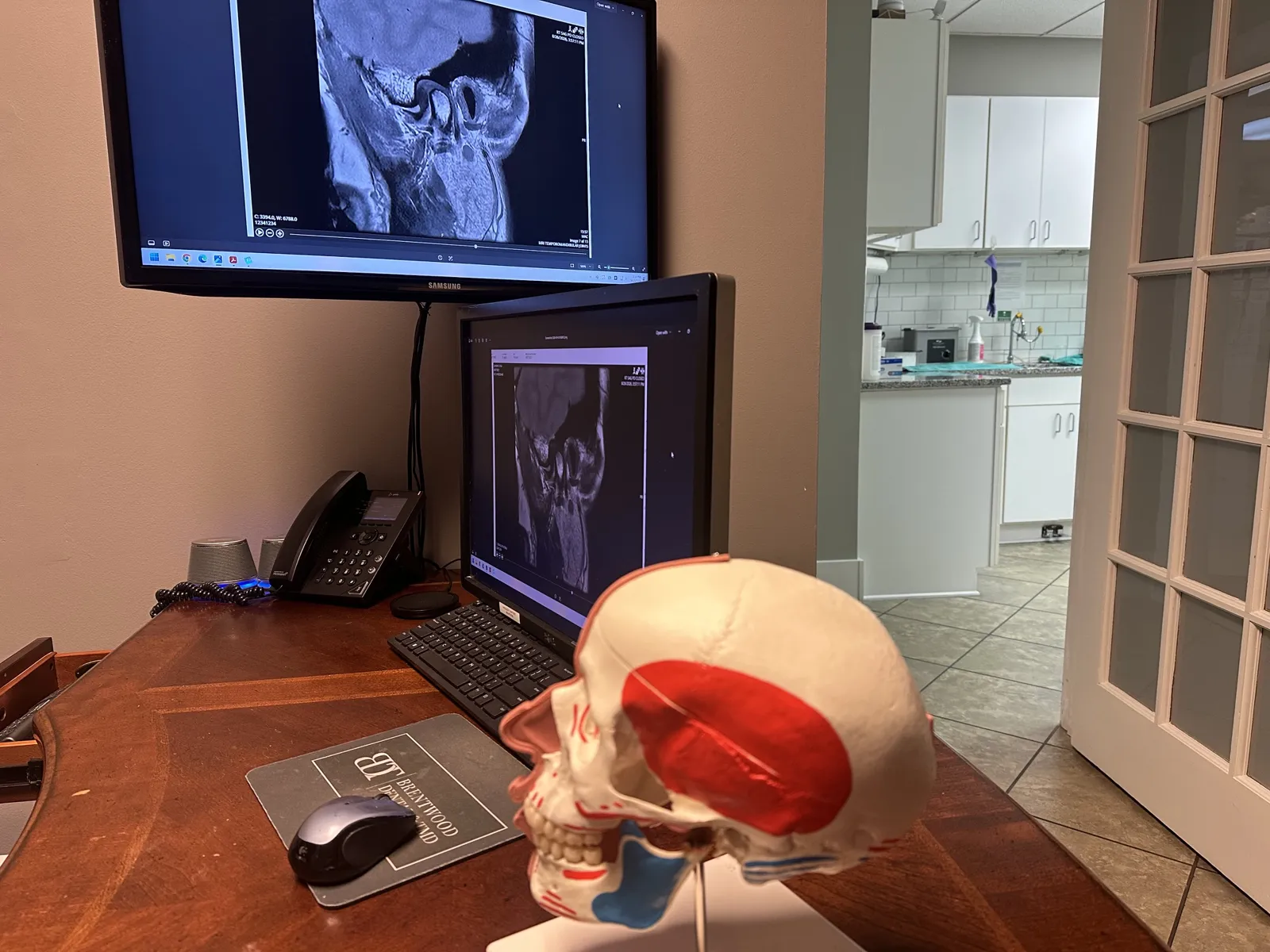
A TMD evaluation should include a detailed history, a hands-on exam of the jaw, head, and neck, and imaging when the joint itself is in question. The NIDCR notes that no widely accepted standard test exists for TMD, so diagnosis depends on the examiner, and that X-ray, MRI, or CT imaging may be recommended. Magnetic resonance imaging (MRI) shows the position and condition of the cartilage disc inside the joint, which X-rays cannot. The NIDCR also recommends starting with conservative, reversible treatment and avoiding treatment that permanently changes the jaw, teeth, or bite.
For jaw-linked pain with no red flags, the reasonable next step is an evaluation with a dentist who works in TMD every day. In the Nashville area, Brentwood Dental & TMD is built for that: roughly 95% of the practice is TMJ/TMD therapy, headache treatment, and complex restorative dentistry, and Dr. Holmes has ordered and interpreted more than 24,000 TMJ MRIs to confirm what is happening inside the joint before treatment starts. When the findings point to the ear, the nervous system, or joint damage that needs surgery, the next step is a referral, and the TMJ/TMD therapy page explains how the evaluation works.
"Over more than 12,000 TMD cases, the patients who struggle longest are usually the ones whose jaw was never examined," says Dennis M. Holmes, DMD at Brentwood Dental & TMD in Brentwood, TN. "An ENT who clears the ear and a neurologist who rules out migraine or nerve pain have done real work. When the pain still changes every time you chew or clench, the jaw is the next place to look, and if what I find points back to the ear or the nervous system, I send the patient there."
A Note for Nashville Physicians
Nashville physicians, ENTs, and neurologists who see patients with jaw-linked pain can send them for a TMD evaluation through the referring doctors page, which accepts referrals for TMJ disorders, headache and BOTOX consults, and complex dental problems. Shared care works best when each clinician keeps the part of the problem that belongs to their field.
ENT vs. Neurologist vs. TMJ Dentist in Nashville: Which Fits Your Symptoms?
Match the clinician to your dominant symptom: signs of ear disease go to an ENT, migraine patterns and shock-like facial pain go to a neurologist, structural joint damage goes to an oral surgeon, and pain that changes with jaw use goes to a TMJ dentist or orofacial pain specialist. The table below lays out each clinician's role side by side.
| Clinician | See first when | Main role | Usually refers out |
|---|---|---|---|
| ENT (otolaryngologist) | Ear drainage, fever, or a change in hearing | Rules out ear, hearing, and sinus disease | Jaw joint and muscle pain once the ear is cleared |
| Neurologist | Migraine pattern, electric-shock facial pain, or headache with neurological symptoms | Diagnoses and manages migraine, trigeminal neuralgia, and other nerve disorders | Jaw-linked headache and TMD for shared care |
| Oral and maxillofacial surgeon | Jaw injury, fracture, or imaging that shows advanced joint damage | Joint procedures, from arthrocentesis to joint replacement | Nonsurgical TMD care |
| Board-certified orofacial pain specialist | Long-standing or widespread face and head pain, or nerve-type pain | Full range of jaw, face, head, and neck pain, including nerve pain and headache | Surgery and restorative dental work |
| TMD-focused dentist | Pain that changes with chewing, clenching, or opening; temple headaches with jaw soreness | Jaw joint and muscle diagnosis, imaging, and reversible TMD care | Ear disease, migraine, and nerve pain, joint surgery |
Most people searching for help with jaw, face, and head pain fit the bottom two rows first, and the table shows why no single clinician owns the whole region. The best first appointment is the one that matches the symptom you notice most.
If your jaw, temple, or ear pain changes when you chew or clench and no emergency warning signs are present, Brentwood Dental & TMD, Nashville's Center for TMJ Treatment & Complex Dentistry, can take a look. Call (615) 371-8888 to schedule a TMD consultation at 5120 Virginia Way in Brentwood, Monday through Thursday.