 BRENTWOODDENTAL & TMD
Published September 2026.

Key Takeaways
A visit with a TMJ dentist in Nashville involves two separate costs: the consultation fee, which each practice sets and which you should confirm by phone before booking, and imaging, where an MRI is the biggest variable and lists at $333 for self-pay patients in the Nashville region on one price marketplace.
- An MRI is not part of every visit. Clinical guidance reserves imaging for cases where the diagnosis is in doubt or conservative treatment has not worked.
- The same scan can cost far more elsewhere. That marketplace estimates the national average at $900.
- You should leave with a named diagnosis, the findings behind it, and whether the next step is reversible.
- Insurance may split the visit between medical and dental plans, and a predetermination estimate is not a guarantee of payment.
The first visit with a TMJ dentist in Nashville is the first dollar you spend on jaw pain, and not knowing that number is often what keeps people from booking at all. The consultation fee is set by each practice, so the fastest way to get the exact amount is to call. What you can know before that call is how the visit is built: what the fee covers, when an MRI gets added, and what that scan costs in the Nashville area, how insurance handles each piece, and what a good consultation should hand you before you leave.
This page covers the first visit: the exam fee and imaging. Pricing a custom splint? See TMJ splint cost in Nashville. For what happens at the exam and how treatment works, see our TMJ and TMD treatment page.
How Much Does a Consultation With a TMJ Dentist in Nashville Cost?
A consultation with a TMJ dentist in Nashville has no standard price, because each practice sets its own exam fee. The TMJ Association states plainly that there are no standardized costs for TMJ treatments and that prices vary by provider and state.
The "average TMJ consultation cost" figures you find online almost always come from individual dental offices describing their own pricing, not from a neutral survey. A number like that tells you what one office charges. It doesn't tell you what the office down the road charges, or what their fee includes.
The reliable way to get a TMJ consultation fee is to ask the office directly, and to ask what the fee covers at the same time. Brentwood Dental & TMD in Brentwood, TN (Nashville area) gives its current consultation fee over the phone at (615) 371-8888.
TMJ consultation fees differ mostly because visits differ. The main variables are how long the exam runs, whether in-office X-rays are bundled into the fee, and whether the dentist reviews imaging you bring from another office. Two fees that look different on the phone may cover very different visits.
What Does a TMJ Consultation Fee Actually Pay For?
A TMJ consultation fee pays for a diagnostic workup: a pain history, a hands-on exam of the jaw muscles and joints, measured jaw movement, a bite exam, and a decision about whether imaging is worth ordering.
Pain history and ruling things out
The history is where much of a temporomandibular disorder (TMD, often called TMJ) diagnosis gets made. The National Institute of Dental and Craniofacial Research (NIDCR) describes TMD as a group of more than 30 conditions affecting the jaw joints and chewing muscles, and notes that jaw and face pain may or may not be TMD at all. Part of what the TMJ consultation fee buys is the work of ruling out tooth, sinus, ear, and nerve causes that feel similar.
Measurements you can check
A TMD exam produces numbers, not impressions. A review in American Family Physician lists signs a clinician looks for, including jaw opening of less than 30 to 35 mm, slow or staggered jaw movement, and the jaw drifting to one side as it opens. Those measurements become the baseline that later progress gets compared against, which is a real part of the value of the first visit.
The imaging decision
The TMJ exam also decides whether imaging is worth paying for. That decision is one of the most valuable things the consultation fee buys, because it's what keeps you from paying for a scan you don't need, or skipping one you do. A step-by-step look at the visit itself is in this guide to what a first TMJ appointment in Nashville measures.
When Does a TMJ Dentist in Nashville Order an MRI, and What Does It Add to the Cost?
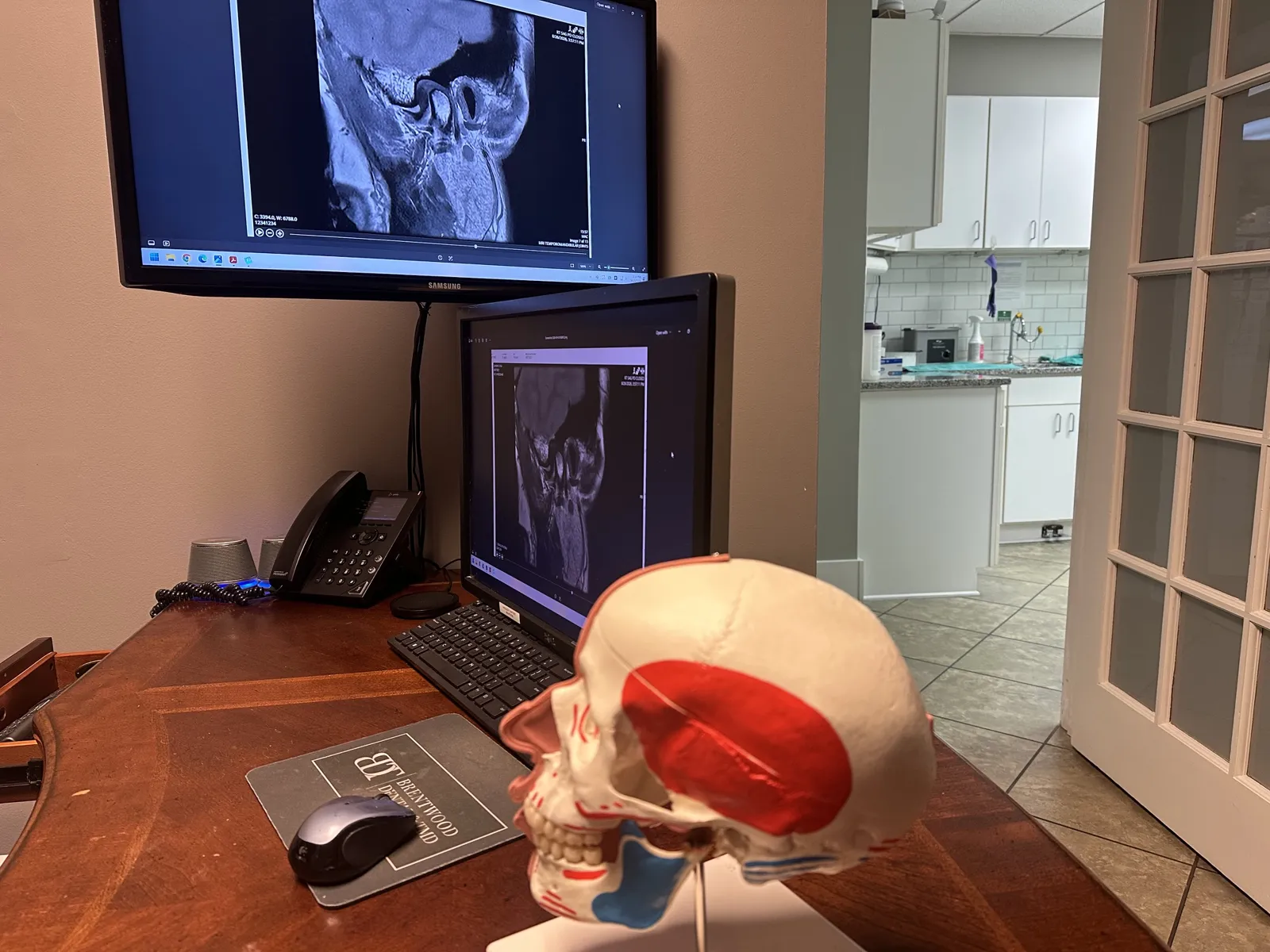
A TMJ dentist in Nashville orders an MRI when the exam points to a disc or joint problem, or before any permanent treatment. In the Nashville region, a self-pay MRI lists at $333 on the MDsave price marketplace.
An MRI is not a standard part of every TMJ consultation. The American Family Physician review states that imaging is indicated when the TMD diagnosis is in doubt or when conservative treatment isn't working, and that MRI is the preferred scan for soft tissue problems such as a displaced disc. A disc problem is the main reason a TMJ patient ends up needing an MRI.
The Nashville-area price for a TMJ MRI depends heavily on where it's done and how it's paid for. MDsave's listing for a standard MRI (no injected dye) covers any one body part, including the TMJ, and the site says its prices are bundled to include related fees. When checked in September 2026, the listing showed a Nashville-region average of $333 against an estimated national average of $900, with individual Middle Tennessee facilities ranging from $293 to $582. Those facilities are spread across the wider region rather than inside Nashville itself.
The cheapest TMJ MRI isn't automatically the right one. The same American Family Physician review cautions that not all imaging centers have the equipment and expertise for TMJ imaging. Before you shop on price, ask your TMJ dentist which facilities they trust for jaw joint scans, then compare prices among those.
The value of a TMJ MRI also depends on who reads it. Dennis M. Holmes, DMD, the dentist at Brentwood Dental & TMD, has ordered and interpreted more than 24,000 TMJ MRIs. A report that says "disc displacement" still has to be matched against what the exam found before it means anything for your treatment plan.
MRI vs. CBCT vs. Panoramic X-Ray: What Each Scan Shows
Each TMJ imaging type answers a different question, which is why a TMJ dentist rarely orders all three. MRI shows the disc and soft tissue. Cone beam computed tomography (CBCT, a 3D dental X-ray) is the American Family Physician review's preferred scan for bone changes in the joint, with a lower radiation dose than conventional CT. A panoramic X-ray gives a wide view of the teeth and jaw and is the recommended first look after jaw trauma or a suspected dental abscess.
No neutral source publishes Nashville-area prices for TMJ CBCT scans or panoramic X-rays, so ask whether either one is included in the TMJ consultation fee or billed as its own line item.
Does Insurance Lower Your TMJ Consultation Cost?
Insurance can lower your TMJ consultation cost, but the exam and any imaging may fall under your medical plan, your dental plan, or neither, depending on how your policy defines jaw joint care.
The split between medical and dental coverage is well documented. A National Academies report found that many health insurers treat the TMJ as part of the structures supporting the teeth and exclude it from medical coverage, while dental plans often exclude TMD treatments delivered by non-dentists. The TMJ Association adds that some policies carry specific TMJ exclusions or dollar caps. More detail is in this guide to TMJ treatment insurance coverage in the Nashville area.
A TMJ MRI is usually performed and billed by an imaging center or hospital, separately from the dental exam. Call the member number on your medical card, ask whether the scan needs prior authorization, and ask which facilities are in network. If you pay cash instead, MDsave says a self-pay purchase may count toward the deductible on a high-deductible plan, though the insurer makes the final call.
How predetermination works for employer dental plans
A predetermination is a written estimate from your dental insurer of what it will pay for a proposed treatment plan. The American Dental Association explains that most dental PPO and indemnity plans offer a voluntary predetermination process rather than requiring preauthorization, and that the estimate reflects your eligibility and remaining benefits on the day it's issued. It is not a guarantee.
Predetermination for TMD care usually happens after the consultation, because the office needs a diagnosis and a proposed plan to submit. If your dental coverage comes through an employer, ask the office to submit a predetermination once the plan is set. The ADA suggests submitting it as close to the treatment date as possible, since benefits used in between can change what the plan pays.
Diagnosis-First Consultation vs. a Same-Day Treatment Quote: Which Is the Safer Spend?
A diagnosis-first consultation is the safer spend. It can cost more on day one when imaging is needed, but a treatment quote issued before a diagnosis risks paying for care that doesn't fit the problem, and then paying again.
Some offices quote a splint or a bite procedure at the first visit, before any imaging decision is made. The National Academies report found that insurance coverage often rewards the care that is best reimbursed rather than the care that is best, and that some dentists still use costly approaches known to be ineffective for TMD. Guidance from the American Dental Association, cited in the American Family Physician review, advises against using irreversible procedures such as braces, bite adjustment, or restorations as the first treatment for TMJ disorders.
The Brentwood Dental & TMD team has seen the cost of skipping diagnosis firsthand. The practice's own TMJ page notes that when a bite splint fails to relieve symptoms, it's often because an accurate diagnosis was never established before the splint was made.
| Diagnosis-First Consultation | Same-Day Treatment Quote | |
|---|---|---|
| What you pay for on day one | Exam, measurements, and an imaging decision | Exam plus a price for a device or procedure |
| Imaging | Ordered when findings point to the joint: MRI for the disc, CBCT for bone | Often skipped before treatment is proposed |
| What you leave with | A named diagnosis, the findings behind it, and a reversible first step | A treatment price, with the diagnosis assumed |
| Main cost risk | Imaging adds cost up front, around $333 self-pay for a Nashville-region MRI | Paying for care that doesn't match the problem, then paying again |
| Fit with federal guidance | Matches NIDCR advice to start conservatively and avoid permanent changes | Conflicts with that advice when the first step is irreversible |
What Should You Walk Out of a TMJ Consultation Knowing?
You should walk out of a TMJ consultation knowing three things: the name of your diagnosis, the exam or imaging findings that support it, and whether the recommended next step is reversible.
"TMJ" is not a diagnosis. NIDCR groups TMD into joint disorders, chewing muscle disorders, and headaches linked to TMD, and a useful consultation tells you which one you have. NIDCR also notes that clicking or popping without pain is common and considered normal, so a click by itself shouldn't be the basis for a treatment plan.
The reversibility question protects your money as much as your jaw. NIDCR advises that, because evidence for many TMD treatments is limited, experts recommend conservative care and avoiding treatments that permanently change the jaw joints, teeth, or bite. If the proposed first step can't be undone, you should hear the reasons before you pay, and you should leave with a written estimate tied to the specific plan.
"The most expensive TMJ visit I see is usually the second one," says Dennis M. Holmes, DMD at Brentwood Dental & TMD in Brentwood, TN. "A patient comes in after paying for a splint that was made before anyone knew what was wrong with the joint, and now we're starting the diagnosis they should have gotten the first time. A consultation should end with a name for the problem and a reason to believe it. If you leave with a device and no diagnosis, you paid for the wrong thing first."
For jaw pain that hasn't settled with self-care, the reasonable next step is a consultation with a TMJ dentist in Nashville who works in TMD daily rather than occasionally. That is what Brentwood Dental & TMD does: roughly 95% of the practice is TMJ/TMD therapy and complex restorative care, and Dr. Holmes has treated more than 12,000 TMD cases. Because it's an independently owned, single-dentist practice, the dentist who examines you is the same one who orders and reads your imaging and builds your plan. Dr. Holmes's training and background are on his bio page.

What Should You Ask a TMJ Dentist in Nashville Before Booking?
Before booking with a TMJ dentist in Nashville, ask five questions: what the fee is, what it includes, how imaging is billed, which insurance plan the visit goes to, and what to bring.
- What is the consultation fee? Get the current number by phone, since posted fees and online averages go out of date.
- What does the fee include? Ask whether the exam, any in-office X-rays, and a findings discussion are all covered in one fee.
- How is imaging billed? Ask whether a CBCT scan is a separate charge, and where an MRI would be done if one is needed.
- Which insurance is billed? Bring both your medical and dental cards and ask which one the exam and imaging go to.
- What should you bring? Bring any jaw or dental imaging from the past year and any splint or night guard you've worn, since recent images may spare you a repeat scan.
Ready to Find Out What Your Visit Will Cost?
The quickest way to get the current consultation fee is to call Brentwood Dental & TMD, Nashville's Center for TMJ Treatment & Complex Dentistry, at (615) 371-8888. The team can walk you through what the visit includes and schedule your consultation.