 BRENTWOODDENTAL & TMD

At a Glance
- Service: TMJ / TMJ therapy, from imaging-based diagnosis through custom splint therapy and headache treatment
- Serving: Spring Hill and the southern Williamson and Maury County corridor, including the Crossings, Wades Grove, and the US-31 / Saturn Parkway area, from the Brentwood office
- Office hours: Monday–Thursday, 7:00 a.m.–4:00 p.m.
- Accepting new patients: Yes
- Key differentiator: A systematic, MRI-guided diagnostic process that separates true joint problems from look-alike conditions before any irreversible treatment

If you want to know what TMJ treatment actually involves before you call, here is the sequence, step by step. There is no mystery to it, and understanding the process is the best way to tell a thorough provider from one who hands out a generic night guard and moves on.
Step one: a real diagnosis, not a guess
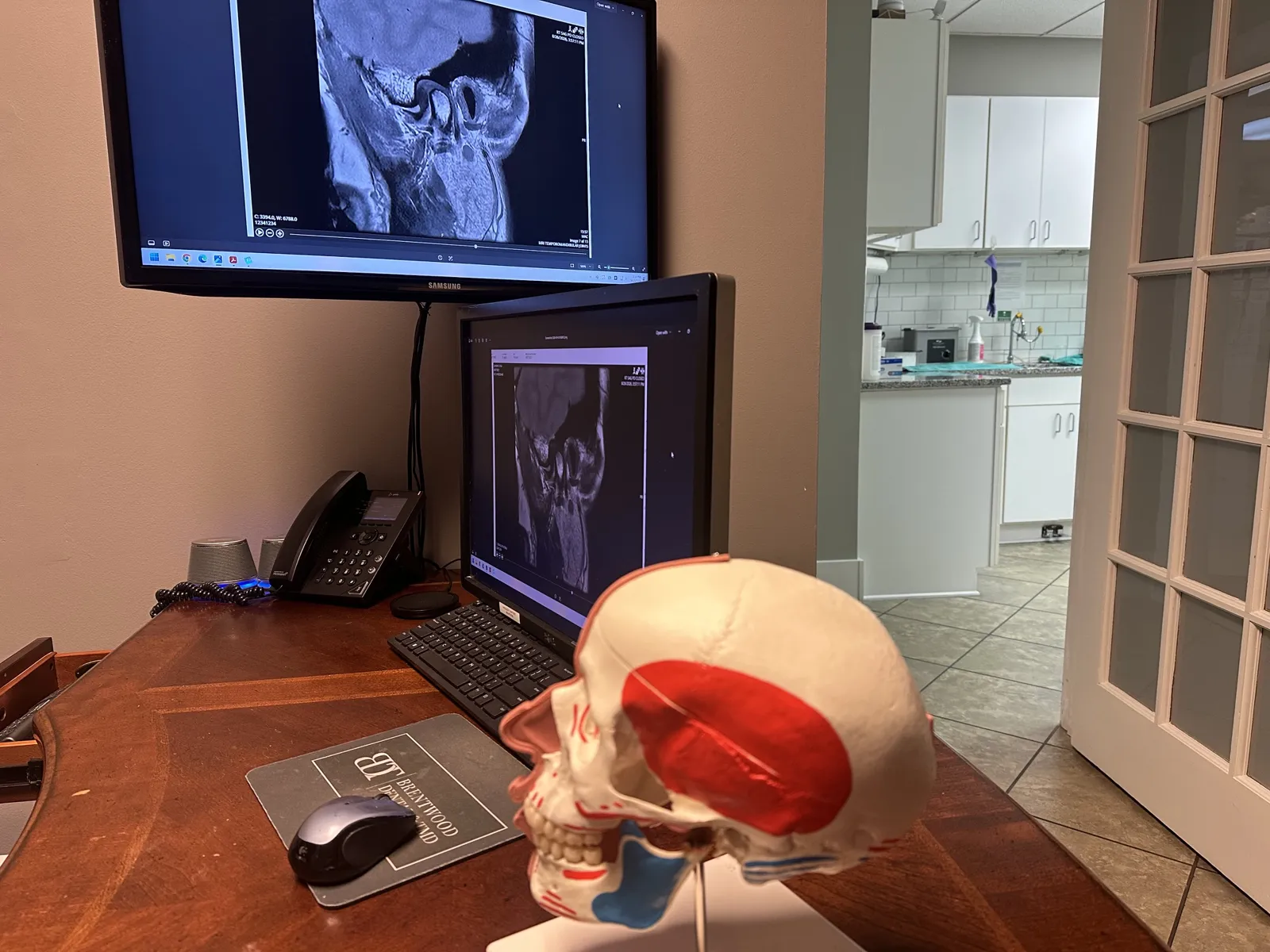
Treatment starts with finding the source. Dr. Holmes takes a full history, examines the joint and the muscles of the jaw, face, and neck, and orders MRI and 3D diagnostic imaging. This matters because popping joints are not all the same. There are eight classifications of internal derangement, and the direction and degree of a disc displacement, medial pole versus lateral pole, change the prognosis and the treatment. Skipping the scan means guessing, and guessing is how people end up with appliances that do nothing.
The Clinician Behind the Process

A diagnostic process is only as good as the clinician running it. Dr. Dennis Holmes has refined his over 30+ years and more than 12,000 TMJ, TMJ, and headache cases, developing a logical, systematic method in a field he openly describes as full of disagreement and guesswork. What sets his record apart is that he has ordered MRI scans across those cases, building a reference for joint disorders that few practitioners can match. For Spring Hill patients making the drive north, that rigor is the reason the trip ends the guessing.
Step two: matching treatment to the finding
Once the classification is clear, the plan follows from it. For many patients that means a custom splint designed for their specific joint position and bite, not a one-size appliance off a shelf. Where an uneven bite is driving the muscle overactivity, addressing the occlusion becomes part of the plan. The point is that each step is chosen because the diagnosis calls for it.
Step three: managing muscle pain when it lingers
Some patients have chronic muscle pain that does not fully settle with primary treatment. For those cases, BOTOX can calm the overactive muscles of mastication. Dr. Holmes uses it deliberately, after a diagnosis is established, never as a first or standalone fix, because most headache and jaw pain traces back to an underlying joint or bite problem that should be corrected first.
What you will feel during and after
The diagnostic visit is non-invasive: exam and imaging, no drilling. As treatment proceeds and the joint and muscles stabilize, the clicking, locking, jaw fatigue, and headaches ease over time. Relief is usually gradual rather than instant, which is the honest expectation for a structural problem.
Who is, and is not, a candidate
You are a candidate if you have jaw noises, locking, an unstable-feeling bite, ear pressure, or temple headaches that have not resolved. A painless click still deserves evaluation, since these problems progress. If the workup points to a vascular migraine or another non-jaw source, that finding redirects your care rather than forcing a TMJ treatment that will not help.

Getting Here from Spring Hill
From Spring Hill, the cleanest route is US-31 (Main Street / Columbia Pike) north, then I-65 north from the Saturn Parkway interchange; exit at Concord Road for the Brentwood office on Virginia Way. Allow roughly 30 to 35 minutes depending on the I-65 commuter volume, which is heavy on this stretch in the morning. Coming from the Wades Grove or the Crossings area, getting to I-65 via Buckner Road or Saturn Parkway is faster than working through downtown Spring Hill.
Because the office opens at 7:00 a.m., Spring Hill patients who already drive north for work can fold a visit into the start of the day instead of adding a separate trip.
Spring Hill Patient Questions
The I-65 commute from Spring Hill is brutal in the morning. When is the best time to schedule?
A: Spring Hill commuters often do best with the earliest slots, since the office opens at 7:00 a.m. and you can arrive before the worst of the northbound I-65 build-up. Mid-morning after the rush is the next-best window. Call (615) 371-8888 to find a time that fits your drive.
Spring Hill has grown so fast that specialist care here is limited. Is the drive to Brentwood worth it?
A: For an accurate, MRI-based TMJ diagnosis, many Spring Hill patients find the 30-something-minute drive worthwhile, since guessing at the problem locally often leads to repeated, ineffective treatment. One thorough workup tends to save time and money over several incomplete attempts.
I work at one of the big manufacturing employers near Saturn Parkway with shift hours. Can the early opening accommodate me?
A: The 7:00 a.m. start works well for shift schedules, especially for workers heading north anyway. Let the team know your shift pattern when you call and they will match you to an open early slot.
My jaw clicks but does not hurt. Is the trip even necessary?
A: Yes, it is worth evaluating. A painless click signals a disc that has shifted, and these joint problems advance over time. Catching it early gives the best chance to stabilize the joint before it becomes painful or locks.
Do you treat patients referred by Spring Hill or Columbia general dentists?
A: Yes. The practice regularly accepts referrals for complex TMJ and bite problems and works alongside your general dentist. If your dentist suspects a joint disorder beyond routine care, a consultation here provides the specialized imaging and diagnosis.
Brentwood Dental & TMJ
5120 Virginia Way, Ste C13, Brentwood, TN 37027
(615) 371-8888
https://brentwooddentalandtmd.com/areas-we-serve/tmj-therapy-in-spring-hill-tn/