 BRENTWOODDENTAL & TMD
Published October 2026.
Key Takeaways
TMJ treatment usually fails for one of four reasons: the appliance or procedure was chosen before a diagnosis was made, it targeted the wrong structure (chewing muscle versus joint disc), it permanently changed the bite for a problem that lived in the joint, or it was a design the patient could not wear.
- The first question to ask about any failed treatment is what it was built to fix, because muscle-based pain and disc-based pain call for different care.
- NIDCR says to stop using any appliance that causes pain; the TMJ Association adds any appliance that increases clenching or shifts your bite.
- Grinding teeth down, crowns to balance the bite, and orthodontics have insufficient evidence as TMD treatments and can make it worse, according to NIDCR.
- A second opinion should restart at diagnosis: a joint-level exam and, when findings point to the joint, MRI, before any new treatment.
If your TMJ treatment did not work, the appliance is usually the least useful thing to examine. What matters is what it was built to fix, and whether anyone established that before it was made. Temporomandibular disorders (TMDs, often called TMJ) cover more than 30 conditions in three broad groups, according to the National Institute of Dental and Craniofacial Research (NIDCR), and a night guard, splint, or bite adjustment made before the condition was classified is a guess about which group you belong to. At Brentwood Dental & TMD in Brentwood, TN (Nashville area), the team has seen firsthand how often a new patient arrives carrying an appliance that did not help, and in most of those cases the appliance was never the real problem.
Failed TMJ treatment tends to fall into four patterns, and each one traces back to a diagnostic step that was skipped or came too late. None of this is a criticism of the dentist who made the appliance. A guard for grinding is a reasonable first move for jaw pain, and general dentists handle first-line care well. The gap is almost always diagnostic rather than a matter of skill, and the failure itself tells you where to look next.
Why Did Your TMJ Treatment Fail?
Most TMJ treatment fails for a diagnostic reason: the appliance or procedure was chosen before the condition was classified, so it targeted the wrong structure, changed the bite unnecessarily, or came in an unwearable design.
NIDCR sorts TMDs into three categories: disorders of the joints, including disc disorders; disorders of the muscles used for chewing; and headaches associated with a TMD. A person can have more than one at the same time. NIDCR also states that there is no widely accepted standard test for a TMD, so the diagnosis comes from a detailed history, a physical examination of the head, neck, face, and jaw, and imaging when the findings call for it. A treatment chosen before that sorting is done is chosen for an average patient, not for you.
The four failure patterns look like this. A night guard made for grinding when the pain was coming from the joint. A splint that calmed the chewing muscles while a displaced disc kept the joint inflamed. Teeth ground down, crowned, or moved with braces to treat a joint that was never stable. And an appliance that was the right idea but built in a way you could not wear every night. Each pattern maps to a missing step: classification, imaging, sequencing, or design with follow-up.
Was Your Night Guard Made for the Wrong Diagnosis?
A night guard is built to protect teeth from grinding and to interrupt clenching, not to treat a displaced disc or an arthritic joint, so it fails when the pain is coming from inside the joint.
A night guard (also called a bruxism splint, occlusal guard, or stabilization appliance) is the appliance most people get first, usually from a general dentist, for jaw pain that looks like grinding. That is a defensible starting point. Mayo Clinic notes that people with jaw pain often benefit from a soft or firm device worn over the teeth, while adding that the reasons these devices help are not well understood. NIDCR describes intraoral appliances as devices that protect the teeth and may help with habit reversal such as clenching, and it says there is not a lot of evidence on whether they improve TMD pain. That is a narrow job description, and it is the reason a guard can be well made and still do nothing for you.
The gap is diagnostic. A guard that keeps the teeth apart does not change the position of a disc sitting in front of the condyle (the rounded top of the lower jaw that moves inside the joint), and it does not change worn joint surfaces. The step that catches this is a joint-level examination before the appliance is made: how far and how evenly the jaw opens, palpation of the chewing muscles and joints, the character of any joint sounds, and how the teeth meet. Cleveland Clinic describes that exam as checking how wide you can open, pressing around the jaw for tenderness, and feeling the joints as they move, with X-rays, CT, or MRI added when needed.
Brentwood Dental & TMD states the same point on its TMJ therapy page: when a bite splint does not relieve symptoms, the usual reason is that an accurate diagnosis was not established before the splint was made, and generic or universal splint designs are not recommended for exactly that reason.
Store-bought guards fail for a simpler reason. Cleveland Clinic’s guidance on mouth guards explains that stock and boil-and-bite guards are cheaper but less effective than custom-made guards against grinding, and that a guard that does not fit well can cause soreness in the teeth, gums, or jaw. The TMJ Association goes further: over-the-counter splints are hard to fit exactly and can move teeth, which means a permanent bite change, and sports mouth guards are not designed for TMJ problems at all. A failed drugstore guard tells you nothing about your diagnosis, because there was never a diagnosis behind it.
Did Your Splint Treat the Wrong Structure, Muscle or Disc?
Muscle pain and disc-related joint pain feel similar but are different conditions; a flat splint built to relax clenching muscles is not designed for a displaced disc, so a splint that helped briefly then stalled often points to the joint.
Muscle pain vs. disc pain: what each one feels like
Myofascial pain (pain in the chewing muscles, mainly the masseter along the jaw and the temporalis at the temple) is the problem a stabilization splint is built to calm, and NIDCR lists pain in the chewing muscles or jaw joint as the most common TMD symptom. A displaced disc is a different problem. The TMJ Association’s explanation of displaced discs describes two stages: anterior displacement with reduction, where the disc slips back into place as the mouth opens and produces a click or pop, and anterior displacement without reduction, where the disc blocks the condyle, limits opening, and is sometimes called closed lock. The pain in a disc problem does not come from the disc itself but from compression of the nerve-rich tissue behind it.
Both problems can exist at once, which is how a splint can help partway and then stop: the muscle component eases, the joint component does not, and you are left on a plateau. The TMJ Association adds a caution worth knowing before anyone hands you an MRI report: many people without TMJ symptoms have displaced discs, so an imaging finding has to line up with the symptoms and the exam before it explains anything.
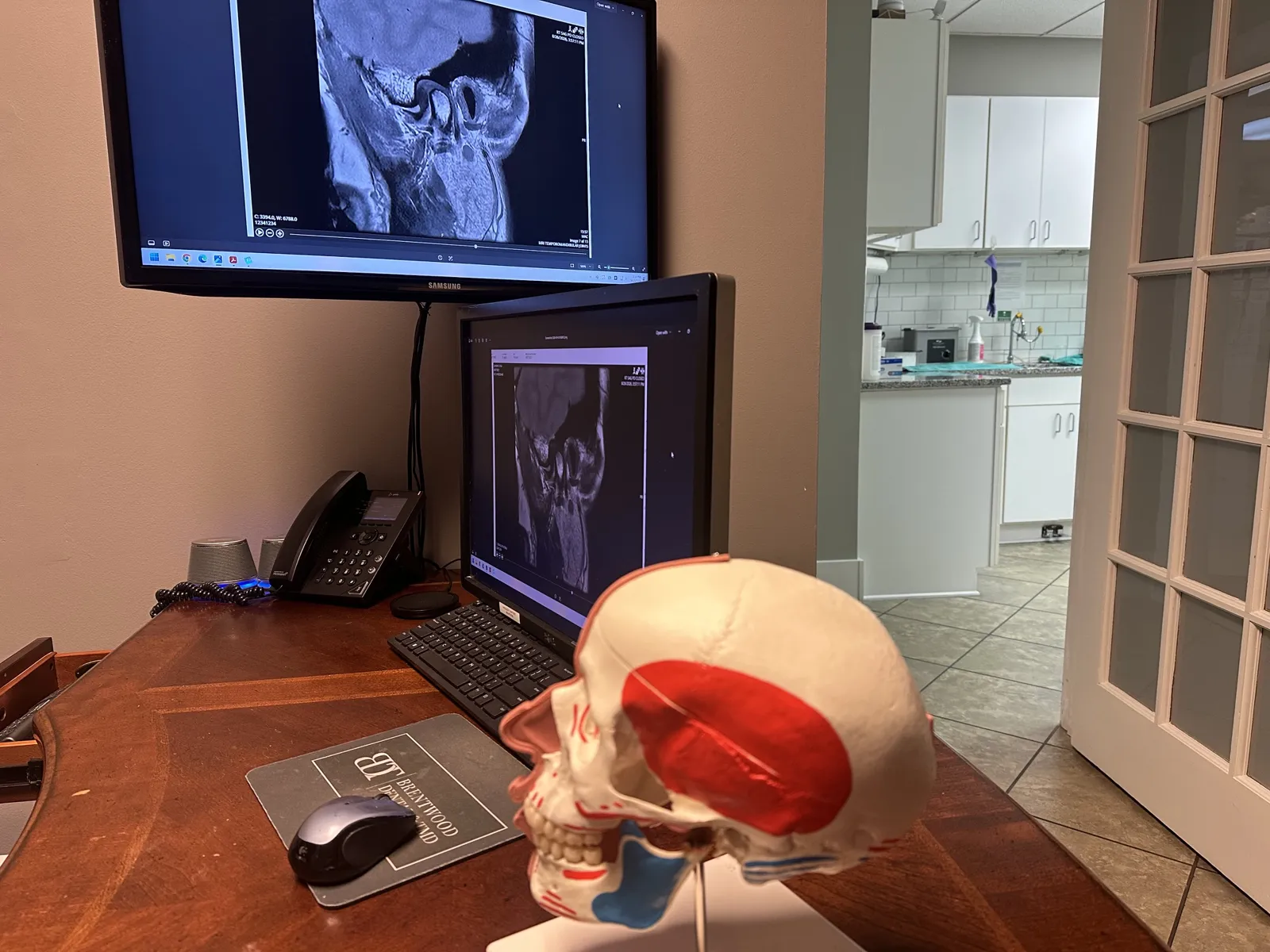
The diagnostic step that separates muscle from disc is imaging of the joint, ordered when the exam points there. Mayo Clinic is specific about what each study shows: dental X-rays show the teeth and jaw, CT (computed tomography) shows the bones of the joint in detail, and MRI (magnetic resonance imaging) shows problems with the joint’s disc and surrounding soft tissue. A disc does not appear on a dental X-ray, which is why a splint can be made and adjusted for months without anyone seeing the structure that is causing the pain.
“The appliance is rarely the mistake,” says Dennis M. Holmes, DMD at Brentwood Dental & TMD in Brentwood, TN. “The mistake is making it before anyone knew whether the pain was coming from the muscle or from the disc. A guard that stops you clenching will not move a disc back where it belongs, and adjusting it ten more times will not change that. When a patient tells me the splint helped for a month and then quit, that history is the most useful thing they bring into the room.”
What about BOTOX that did not work?
Therapeutic BOTOX (botulinum toxin type A injected into the masseter and temporalis muscles) is a muscle treatment, so a BOTOX failure says something specific: the pain may not be muscle-driven, or a joint problem keeps re-triggering the muscles. NIDCR notes that botulinum toxin is FDA approved for some conditions, such as migraine, but not for TMDs, that study results have been mixed, and that it remains unclear whether the treatment relieves TMD symptoms. Brentwood Dental & TMD’s own position, stated on its TMJ therapy page, is that BOTOX should not be given before a TMJ diagnosis has been established. An injection that did nothing is a reason to look at the joint, not a reason to repeat the injection.
Did Irreversible Bite Work Target a Joint Problem?
Occlusal treatments for TMD, meaning grinding teeth down, crowns placed to balance the bite, or orthodontics, have insufficient evidence and can make the problem worse, according to NIDCR, so a failed bite change points to the joint, not the teeth.
NIDCR is direct on this point. For years, misaligned teeth were thought to cause TMDs, but current evidence does not support a strong link, and research does not support the belief that a bad bite or braces cause a TMD. NIDCR groups occlusal treatments, meaning placing crowns, grinding down teeth (called occlusal adjustment or equilibration), and moving teeth with orthodontics, with the more complex procedures, and it states that there is insufficient evidence they treat TMDs and that in some cases they make the problem worse. Its advice before any of them is to ask about simpler treatments first, to ask how the procedure would help your specific TMD, and to get second opinions from qualified medical or dental specialists.
The sequencing error explains most failed bite work. A changed bite is often a result of a joint problem rather than its cause. NIDCR lists a change in the way the upper and lower teeth fit together among the symptoms that may signal a TMD. If a disc has displaced or the joint surfaces have changed, the teeth meet differently because the joint moved. Grinding or crowning the teeth to match that new position builds a permanent bite on a joint that may keep changing, and when the joint shifts again the bite is off again, this time with less tooth structure to work with.
Brentwood Dental & TMD’s TMJ therapy page states the practice position plainly: the position of the disc, including whether a displacement sits at the lateral or medial pole of the condyle, must be determined before any irreversible dental treatment, and it names equilibration, orthodontics, prosthodontics, and jaw surgery specifically. That is the step that would have caught this failure: joint classification, and a period of stability, before anything permanent is done to the teeth. Restorative dentistry still has a place for teeth that are worn, cracked, or broken, but it comes after the joint has been diagnosed and stabilized, not as the treatment for the joint.
The TMJ Association draws the same line from the patient side. It describes two reasons a dentist might propose a splint: to relieve pain and improve function, or as the first step in a multi-step plan in which the splint changes the bite and jaw position and then orthodontics or crowns make that position permanent. The second approach, in its words, is not supported by current scientific evidence and poses serious risks because it is irreversible. A repositioning splint worn for more than six weeks, it adds, raises the risk of permanent bite changes. If bite work failed, the next step is not more dentistry. It is a joint diagnosis.
Was It a Design You Could Not Wear?
An appliance that gags you, strains the front teeth, increases clenching, or shifts your bite will be abandoned or cause new problems, and NIDCR and the TMJ Association both say to stop wearing it and get re-evaluated.
Splint designs fail on wearability in predictable ways, and the TMJ Association catalogs them. A flat plane stabilization splint covers all the upper teeth and is meant to reduce grinding and relax sore muscles, but because the lower teeth can still contact it, it does not prevent clenching, and in some patients the condition is aggravated by it. An anterior biteplane contacts only the six lower front teeth and prevents both clenching and grinding, but it is worn only at night because constant wear can let the back teeth shift. An NTI-tss appliance (Nociceptive Trigeminal Inhibition Tension Suppression System) fits on the upper front teeth only, which puts heavy stress on those teeth, and its small size carries a risk of being swallowed or inhaled if it comes off during sleep. Some patients find that any splint causes or increases clenching and grinding, and the TMJ Association’s advice in that case is to stop wearing it and talk to the dentist.
NIDCR’s rule is shorter: if an appliance causes pain, stop using it and consult your dentist or doctor, and make sure no appliance is designed to permanently change your bite. Cleveland Clinic adds the practical side: a guard that does not fit well causes soreness, custom-made guards are usually more comfortable than store-bought ones, and a dentist can check any guard and adjust it.
The step behind wearability is design matched to diagnosis, plus follow-up. The TMJ Association describes normal splint care as fitting, readjustment, and follow-up appointments to check progress and readjust the appliance when needed. Having treated more than 12,000 TMJ and TMD patients, Dr. Holmes has found that an appliance abandoned in the first two weeks usually failed on design before it ever had a chance to fail on diagnosis. A guard you stopped wearing is not evidence that appliances do not work for you. It is evidence that this design did not fit this diagnosis or this mouth, and that nobody adjusted it before you gave up on it.
Boil-and-Bite Guard vs. Dentist-Made Night Guard vs. Diagnosis-Specific Splint: Which One Was Built for Your Problem?
A boil-and-bite guard only separates the teeth, and a dentist-made night guard protects them with an accurate fit. A diagnosis-specific splint is designed and adjusted for a named muscle or joint condition after an exam.
NIDCR treats all three as one category of intraoral appliance, and it says the evidence that any of them improves TMD pain is limited. The distinction that matters is not the name on the appliance but the process behind it: whether a diagnosis came first, and whether the design was chosen and adjusted for that diagnosis. The first two columns below most often “fail” at a job they were never built to do.
| Boil-and-bite guard (store-bought) | Dentist-made night guard | Diagnosis-specific splint | |
|---|---|---|---|
| Who makes it | You, at home, by softening it and biting into it | A dentist, from an impression of your teeth | A dentist, after a joint-level exam and, when indicated, imaging |
| Diagnosis behind it | None | Usually bruxism (grinding or clenching), with the joint given a screening check | A classified TMD: muscle, disc, or joint, sometimes more than one |
| Built to do | Put a layer of plastic between the teeth | Protect the teeth from grinding wear with an accurate fit and interrupt clenching | Address the named condition, then be readjusted at follow-up visits |
| Bite-change risk | Can move teeth because the fit is imprecise (TMJ Association) | Low for a flat stabilization design; NIDCR says no appliance should be built to permanently change the bite | Depends on design; repositioning designs raise bite-change risk when worn long term (TMJ Association) |
| What a failure tells you | Nothing about your joint, because there was no diagnosis | The pain source is probably not simple grinding | The classification or the design needs a second look, and imaging may be the missing step |
Read the table from the bottom row up. What a failure tells you depends entirely on what the appliance was supposed to do. A drugstore guard that did nothing is not information about your joint. A dentist-made guard that did nothing suggests the pain source is not simple grinding. A diagnosis-specific splint that did nothing means the classification or the design needs a second look, and that is a different conversation from “try another guard.”
What Should a Second Opinion on Failed TMJ Treatment Include?
A second opinion on failed TMJ treatment should restart at diagnosis: a joint-level exam of opening, tracking, muscles, joint sounds, and bite, a review of every appliance you have tried, and MRI when the findings point to the joint.
Starting over is the whole point. NIDCR advises getting second opinions from qualified medical or dental specialists before any procedure that goes into the joint or changes the teeth, and it suggests seeking that opinion from an orofacial pain specialist where possible. Mayo Clinic frames the handoff the same way: when the suggested treatments do not give enough relief, you may be referred to a professional who specializes in TMJ disorders. Orofacial Pain became the twelfth dental specialty recognized by the American Dental Association in 2020, according to the American Academy of Orofacial Pain, and a board-certified orofacial pain specialist is one legitimate path. A dentist whose practice is largely devoted to TMD and who images the joint before treating it is another, and both of those facts can be checked.
Bring everything. Every appliance you have been given, including the ones you stopped wearing, any imaging that was done, and a written timeline of what helped, for how long, and when it stopped. The wear pattern on an old guard and the “helped for a month, then quit” history are both diagnostic. The first-visit guide to TMJ treatment in Nashville walks through what that exam measures and what you leave with.
For TMJ treatment that has already failed once, the reasonable next step is an evaluation with a dentist who classifies the joint before proposing anything new. In the Nashville area, that is what Brentwood Dental & TMD is set up for: roughly 95% of the practice is devoted to TMJ/TMD therapy, headache treatment, and complex restorative care, and Dr. Holmes has personally ordered and interpreted more than 24,000 TMJ MRIs, which is the specific skill a second opinion on a failed splint depends on, because the question is usually whether the problem lives in the muscle or in the disc. The TMJ / TMD therapy page describes how that evaluation is structured.
The office sits in Brentwood, a short drive from Nashville, Franklin, Nolensville, Spring Hill, and Murfreesboro, and the 7:00 a.m. start Monday through Thursday means a second-opinion visit from the ring counties does not have to cost a full workday. If you are still deciding whether to keep the problem with your general dentist or escalate it, the TMJ specialist vs. general dentist guide lists the signs that a case has outgrown first-line care, and a failed night guard is one of them.
Frequently Asked Questions
Why is my night guard not helping my TMJ?
A night guard protects teeth from grinding and may interrupt clenching, so it does not help when the pain is coming from a displaced disc or worn joint surfaces rather than from the chewing muscles. NIDCR says there is not a lot of evidence that intraoral appliances improve TMD pain in general, and it lists joint and disc disorders as a separate category from muscle disorders. If the guard was made without a joint-level exam, the likeliest explanation is that it was built for a diagnosis that was never confirmed.
Can a night guard make TMJ worse?
Yes, in some patients. The TMJ Association notes that a flat stabilization splint does not prevent clenching because the lower teeth can still contact it, and some people clench or grind more with a splint in place. NIDCR’s guidance is to stop using any appliance that causes pain and consult your dentist, and to make sure no appliance is designed to permanently change your bite.
How long should I wear a TMJ splint before deciding it is not working?
There is no fixed trial period published by NIDCR or the TMJ Association, but both say to stop right away if the appliance causes pain, increases clenching, or changes your bite. The TMJ Association describes normal splint care as fitting, readjustment, and follow-up visits to check progress, so the fair test is wearing it as prescribed through those follow-ups. If nothing has changed after that, the next step is re-evaluation rather than more months of wear.
What is the difference between a night guard and a TMJ splint?
NIDCR treats night guards, splints, stabilization appliances, and occlusal splints as one category of intraoral appliance that fits over the teeth and does not change the bite. The practical difference is the process behind the appliance: a night guard is usually made to protect teeth from grinding, while a diagnosis-specific splint is designed and adjusted for a named muscle or joint condition after a joint-level exam and, when indicated, imaging. The TMJ Association lists several distinct designs, including flat plane, anterior biteplane, NTI, and repositioning splints, each with different uses and risks.
Can fixing my bite cure TMJ?
No. NIDCR states that research does not support the belief that a bad bite causes TMDs, and that occlusal treatments such as placing crowns, grinding down teeth, or moving teeth with orthodontics have insufficient evidence as TMD treatments and in some cases make the problem worse. A bite that has changed is often a symptom of a joint problem, so the joint needs to be diagnosed before any permanent change is made to the teeth.
Why did BOTOX not work for my TMJ?
BOTOX relaxes chewing muscles, so it does not help when the pain source is a displaced disc or arthritic change inside the joint, and a joint problem can keep re-triggering the muscles after the injection wears off. NIDCR notes that botulinum toxin is not FDA approved for TMDs and that study results on its effectiveness have been mixed. A failed injection is a reason to have the joint itself evaluated and, when the exam points there, imaged.
Where can I get a second opinion on TMJ treatment in Nashville?
A second opinion on TMJ treatment in Nashville should come from a provider who restarts at diagnosis: a joint-level exam, a review of every appliance you have tried, and MRI when the findings point to the joint. NIDCR suggests an orofacial pain specialist where possible, and a dentist whose practice is largely devoted to TMD and who images the joint before treating is another checkable option. Ask any practice what share of its caseload is TMD and whether it images the joint before proposing treatment.
Does a failed TMJ treatment mean I need surgery?
No. NIDCR says surgery should only be considered when there is joint damage that other procedures cannot fix, or when severe symptoms persist despite trying other treatments, and it notes there are no long-term studies on the safety or effectiveness of open TMJ surgery. Most first treatments that fail do so for a diagnostic reason, and the next step is a joint-level evaluation, not an operation.
If your TMJ treatment did not work, bring the appliance and the history to Brentwood Dental & TMD, Nashville’s Center for TMJ Treatment & Complex Dentistry. Call (615) 371-8888 or schedule a consultation online, Monday through Thursday from 7:00 a.m.