 BRENTWOODDENTAL & TMD
Published October 2026.

Key Takeaways
TMJ surgery cost in Nashville depends on which of four procedures you need, with no published price at any level: a needle flush of the joint (arthrocentesis) done in an office sits at the bottom, and total jaw joint replacement sits at the top, with average U.S. hospital charges of $196,526 per stay in 2022 before insurance discounts.
- Only 5 to 10 percent of people with TMJ disorders need surgery, according to the oral surgeons’ national association, and federal guidance reserves open surgery for joints that are structurally damaged or still painful after other treatment.
- Major insurers require a letter of medical necessity, imaging, and at least six weeks of documented conservative care before approving arthrocentesis.
- Tennessee’s insurance department has barred blanket TMJ exclusions in state-regulated major medical policies since 1988.
- Uninsured and self-pay patients are entitled to a written good faith estimate under federal law.
If you are searching for TMJ surgery cost in Nashville, someone has probably raised surgery as a possibility, and the cost question has landed on top of an already frightening one. This article covers the four surgical procedures for temporomandibular joint disorder (TMD, often just called TMJ) from least to most invasive, what is known about each one’s cost, how Tennessee insurance treats TMJ surgery, and why most people with a jaw joint problem never reach an operating room.
How Much Does TMJ Surgery Cost in Nashville?
No Nashville surgical group publishes a TMJ surgery price, and the TMJ Association states there are no standardized costs for TMJ treatments, so the bill is set by which of four procedures you need, where it is done, and how you are anesthetized. The TMJ Association, a patient advocacy nonprofit the National Institutes of Health lists as a resource, notes that costs vary by provider and by state, so the only number you can rely on is a written estimate for your own procedure, facility, and coverage.
The four procedures form a ladder, and the TMJ Association’s surgery guide describes each rung. Temporomandibular joint arthrocentesis (a joint flush, or lavage) washes the joint through two needles and can be done in an oral surgeon’s office. Temporomandibular joint arthroscopy adds a small camera so the surgeon can see inside the joint, remove scar tissue, or reposition the disc. Open-joint surgery (arthrotomy, also called arthroplasty) means an incision in front of the ear to reshape bone, repair the disc, or release a fused joint. Total jaw joint replacement (alloplastic temporomandibular joint reconstruction) removes the natural condyle and screws in an artificial joint.
Only the top rung has hard national data, covered below. Beneath joint replacement, no comparable U.S. dollar figure has been published, so this article does not invent one. For the non-surgical side of the ledger, start with our guide to TMJ treatment cost in Nashville.
How Much Does TMJ Arthrocentesis or Arthroscopy Cost?
There is no published national price for TMJ arthrocentesis or arthroscopy, but both are outpatient procedures, and arthrocentesis can be done in an office under local anesthesia with sedation, which puts it at the bottom of the surgical cost ladder. Cigna’s current TMJ surgery coverage policy describes arthrocentesis as done under in-office sedation or in a hospital under general anesthesia, and arthroscopy as a general anesthesia procedure, often still outpatient.
An arthrocentesis or arthroscopy bill therefore turns on three questions: office or hospital, sedation or general anesthesia, and one joint or both. Federal billing rules describe any estimate as a primary provider, co-providers such as the anesthesiologist, and a facility, each billing separately. An office arthrocentesis with IV sedation carries the first; a hospital arthroscopy carries all three, plus the imaging that justified it and any physical therapy afterward.
Because nothing national exists for these two procedures, look up charges for your own ZIP code. FAIR Health Consumer, a nonprofit with the nation’s largest repository of commercial claims data, shows both the billed charge and the in-network allowed amount for a procedure in your area, and paired with the codes on your surgeon’s estimate it gives you a defensible range.
How Much Does Jaw Joint Replacement Cost?
Jaw joint replacement cost is the highest on the TMJ surgical ladder: a 2026 analysis in the British Dental Journal, drawn from the federal National Inpatient Sample, found mean hospital charges for a total TMJ replacement of $153,951 in 2020 and $196,526 in 2022, a 27.7 percent rise in two years. Two cautions keep that number honest. A hospital charge is the amount billed, not the amount an insurer has agreed to pay or the share you owe, and the figure is per hospitalization, which may involve one joint or both.
The implant is a regulated, tracked device. The FDA requires premarket approval, its most stringent device review, for every TMJ implant and has tracked them since 1993 because a failure could cause serious harm. The TMJ Association lists two manufacturers approved to market total joint devices in the United States and calls replacement a last resort after all other treatment has been tried.
The number that matters most may be how rare the procedure is: the same analysis counted 575 TMJ replacement hospitalizations in 2020 and 770 in 2022 across the entire country. Set against the National Institute of Dental and Craniofacial Research (NIDCR) estimate that TMD affects about 5 percent of U.S. adults, jaw joint replacement is the outcome for a very small fraction of people with a jaw problem.
Does Insurance Cover TMJ Surgery in Tennessee?
Often yes, and more often than for splints or other non-surgical care: the TMJ Association notes that some policies restrict TMJ coverage to surgical procedures, and Tennessee bars blanket TMJ exclusions in state-regulated major medical policies. A 1988 Tennessee Department of Commerce and Insurance bulletin states that accident and health policies issued in the state must cover conservative (Phase I) TMJ treatment, should also cover TMJ surgery when a physician could perform the procedure, may not exclude TMJ outright, and may not limit coverage to surgery alone.
That bulletin applies to policies issued in Tennessee, so if your coverage comes through a large employer, ask your benefits coordinator whether the plan is a Tennessee-issued policy or an employer-funded plan with its own rules. Either way, TMJ surgery is billed to medical insurance, not dental, and medical plans have their own gate.
What a major insurer requires before it will approve TMJ surgery
Cigna’s coverage policy, effective December 2025, is a public example of that gate. It requires a letter of medical necessity for every TMJ surgery request, with a detailed history, imaging results, and documentation of prior treatment. Arthrocentesis is considered medically necessary only when pain or restricted motion persists after at least six weeks of noninvasive care such as medication, physical therapy, and an intraoral appliance; arthroscopy requires that same six weeks plus imaging showing joint pathology that needs structural correction; and joint replacement requires a condition such as ankylosis, a failed graft or prior implant, or loss of condylar height, confirmed on MRI or CT. Ask the surgical office to submit the pre-determination before the procedure is scheduled.

Why Do Most TMJ Patients Never Need Surgery?
Because only 5 to 10 percent of people with TMJ disorders require surgical treatment, according to the patient information site of the American Association of Oral and Maxillofacial Surgeons (AAOMS), the surgeons’ own national association. NIDCR adds that many TMDs are temporary and resolve on their own, and that experts recommend conservative treatment and avoiding surgery or anything that permanently changes the joint, teeth, or bite, because evidence for many TMD treatments is limited.
Part of the reason is anatomy. The AAOMS 2024 clinical statement divides TMD into disorders of the chewing muscles and disorders of the joint itself. Muscle problems, which include most pain from clenching and grinding, get rest, medication, habit change, an orthotic appliance, and physical therapy; the statement lists no surgical treatment for them, and notes that painless popping or clicking is not necessarily an indication for any treatment. Surgery belongs to the joint category, and only to the part of it that fails conservative care or shows structural damage.
The TMJ Association puts the other half plainly, quoting NIH guidance: there are no standards to identify the people most likely to benefit from surgery, and failure to respond to conservative treatment does not automatically mean surgery is necessary.
Arthrocentesis vs. Arthroscopy vs. Open Surgery vs. Joint Replacement: Which One Fits Which Problem?
The procedure, if any, follows the diagnosis: a displaced disc with a jaw that locks points toward arthrocentesis or arthroscopy, adhesions, bone spurs, or disc damage that need direct repair point toward open surgery, and a joint that has fused, been badly injured, failed a prior operation, or lost its height points toward replacement. The table below uses the TMJ Association’s procedure descriptions, NIDCR’s evidence notes, and the only cost data that exists.
| Procedure | Where and how it is done | Recovery | What it treats | Cost data |
|---|---|---|---|---|
| Arthrocentesis (joint flush) | Office under local anesthesia with IV sedation, or hospital outpatient under general anesthesia | Normal function in two to three days for most people | Displaced disc; often the first surgical step. NIDCR: helps pain and opening, results vary | No published national figure; lowest rung because it can be done in an office |
| Arthroscopy | Hospital outpatient, general anesthesia, 30 minutes to two hours | Several days to a week; about three days off work | Seeing inside the joint; removing adhesions, smoothing bone, repositioning the disc. NIDCR: works moderately well | No published national figure; adds facility, operating room, and anesthesia fees |
| Open-joint surgery (arthrotomy or arthroplasty) | Hospital, general anesthesia, one to two hours | Three to eight weeks | Reshaping bone, repairing or removing the disc, releasing a fused joint, removing tumors | No published national figure; NIDCR reports no long-term safety or effectiveness studies |
| Total joint replacement | Hospital admission, general anesthesia; FDA-approved custom or stock implant | Varies; prescribed diet and exercises, often physical therapy | Ankylosis, severe injury, failed prior surgery, arthritis, loss of joint height | Mean hospital charge of $196,526 per stay in 2022 (British Dental Journal, 2026); a list charge, before insurance |
What Should Happen Before Anyone Recommends TMJ Surgery?
Three things should exist before surgery is on the table: a diagnosis that names which of the more than 30 temporomandibular disorders you have, imaging that shows the actual condition of the joint, and a documented trial of conservative care. NIDCR’s advice before any procedure is to ask about simpler treatments first, to have the provider explain how it helps your specific TMD and what the risks are, and to get second opinions from qualified specialists.
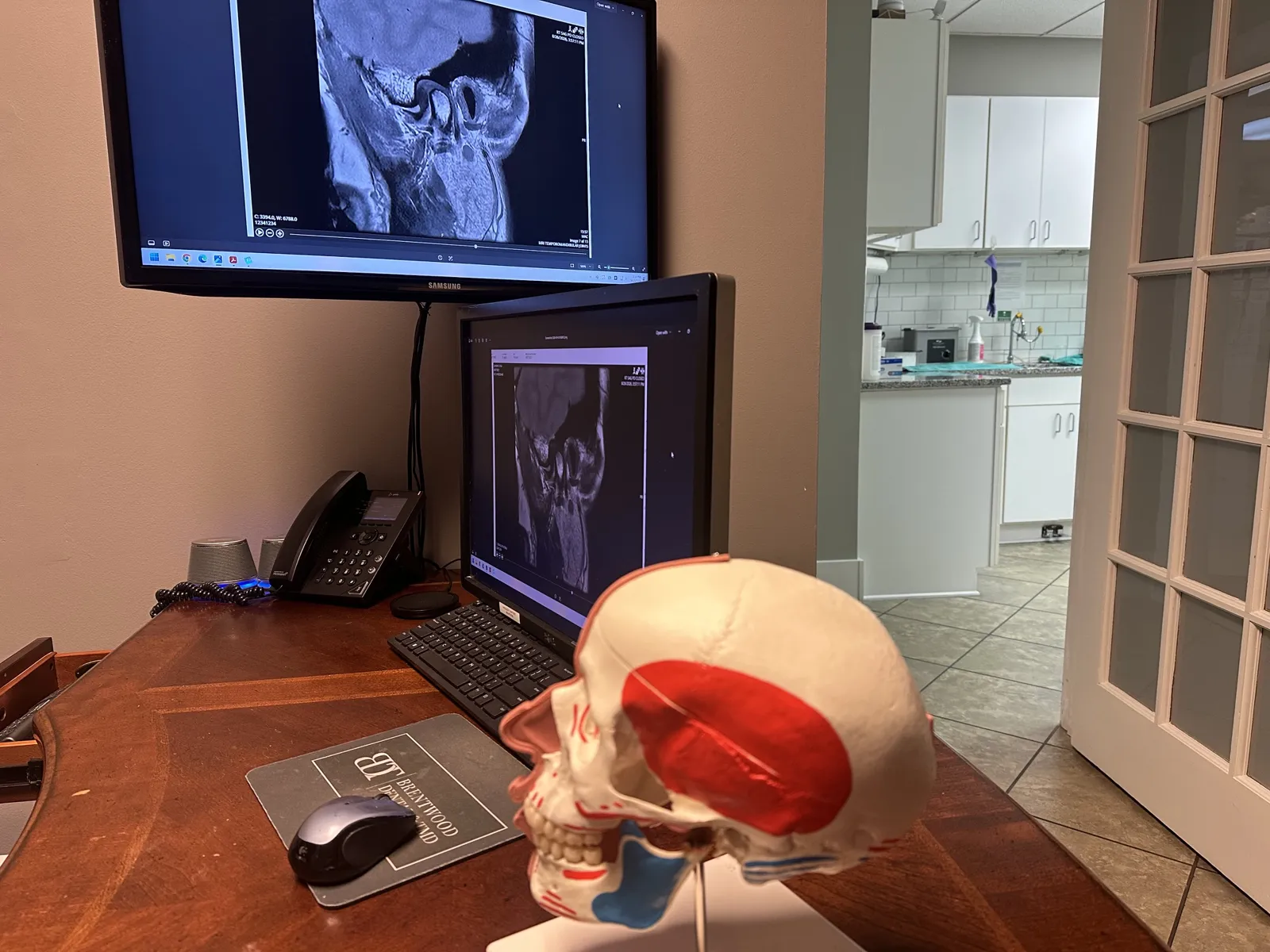
Imaging carries most of that weight, because no exam alone can show whether a disc is displaced, whether it is reducing, or whether the condyle has lost bone; the AAOMS statement lists MRI, CT, and TMJ radiographs as the appropriate tests for joint disorders.
Dennis M. Holmes, DMD at Brentwood Dental & TMD in Brentwood, TN (Nashville area), has treated more than 12,000 TMD patients over 30-plus years, and he describes the surgical ones this way:
“The patients I have sent to a surgeon over 30 years had something I could point to on the scan: a disc that would not reduce and a jaw that stayed locked through a real course of conservative care, a joint that had fused, or a condyle that had lost its height. Pain by itself was never the reason. When someone comes in already scheduled for surgery and the imaging does not show structural failure, that is the time to slow down, not speed up.”
Dennis M. Holmes, DMD, Brentwood Dental & TMD
When Is a Surgical Consult the Right Next Step in Nashville?
A surgical consult is the right next step when imaging shows structural damage inside the joint and a real course of conservative care has not restored function, when the jaw is locked and will not release, or when the joint has fused, been fractured, or lost height. Those match NIDCR’s two conditions for open surgery: joint destruction that other procedures cannot fix, and severe symptoms that persist despite other treatment. The Mayo Clinic describes surgery as usually a last resort after conservative measures have failed, and adds the simplest red flag: seek care if you cannot open or close your jaw completely.
In Nashville, that consult usually happens at an oral and maxillofacial surgery group or at the academic medical center, and many readers are already in that referral path. A conservative evaluation is not a rival to that consult; it is the step before it, and it changes what the surgeon has to work with.
If you have been told you may need TMJ surgery, or you are starting to wonder, the reasonable step before the surgical consult is an evaluation from a dentist who reads TMJ imaging every day and has no stake in whether you end up in an operating room. In the Nashville area, that is what Brentwood Dental & TMD does. Dr. Holmes does not perform TMJ surgery and refers surgical cases out, so he has no financial reason to steer you toward an operation, and he has personally ordered and interpreted more than 24,000 TMJ MRIs and trained at the Piper Clinic in St. Petersburg, Florida, a surgeon-led TMJ program, which is the background you want in the person telling you whether your joint is a surgical joint at all. You can read how that TMJ and TMD evaluation works before you call.
How Do You Get a Real TMJ Surgery Cost Estimate in Nashville?
Ask the surgical office for a written estimate that lists the procedure codes, the facility, the type of anesthesia, and the surgeon’s fee, then send those codes to your insurer for pre-authorization and run them through FAIR Health’s lookup; if you are uninsured or paying yourself, federal law requires a written good faith estimate within three business days of your request. The No Surprises Act, in force since January 2022, requires providers and facilities to give uninsured and self-pay patients a good faith estimate when they schedule care in advance or ask for one, and you can request one from any co-provider, such as the anesthesiologist. If the final bill is at least $400 above the estimate, you can dispute it through a federal process. Under the federal hospital price transparency rule, every hospital must also post its standard charges online, so a Nashville hospital’s facility price for an arthroscopy or a joint replacement is a public document.
Before you agree to anything, ask three more questions: whether the estimate covers one joint or both, what happens to it if an arthroscopy is converted to open surgery during the operation, and, for a joint replacement, whether the device is custom or stock and whether the implant is included in the facility quote.
Frequently Asked Questions
How much does TMJ surgery cost without insurance?
There is no published national price, and no Nashville surgical group posts one; the TMJ Association states that no standardized costs exist for TMJ treatments. Without insurance, federal law requires the surgical office to give you a written good faith estimate before the procedure, and you can dispute a bill that comes in $400 or more above it.
Is TMJ surgery covered by medical or dental insurance?
TMJ surgery is billed to medical insurance, and medical plans are more likely to cover surgery than non-surgical TMJ care. A major insurer’s policy requires a letter of medical necessity, imaging, and at least six weeks of conservative care first. In Tennessee, state-regulated major medical policies may not exclude TMJ treatment outright under a 1988 insurance department bulletin.
How much does TMJ arthrocentesis cost?
No national figure is published for TMJ arthrocentesis, but it is the least expensive TMJ surgery because it can be done in an office with two needles under local anesthesia and IV sedation, with most people back to normal function in two to three days. The bill rises if it is done in a hospital under general anesthesia.
How much does jaw joint replacement cost?
A 2026 British Dental Journal analysis of national inpatient data found mean U.S. hospital charges for a TMJ total joint replacement of $196,526 per hospitalization in 2022, up from $153,951 in 2020. Those are hospital list charges, not negotiated insurance payments or your share, and the implant, the anesthesia, and whether one or both joints are replaced all affect the final bill.
How many people with TMJ actually need surgery?
About 5 to 10 percent, according to the American Association of Oral and Maxillofacial Surgeons’ patient site. The National Institute of Dental and Craniofacial Research reports that many TMDs are temporary and resolve on their own, and that conservative treatment is recommended first because evidence for many TMD treatments, including surgery, is limited.
If TMJ surgery has been raised as an option for you, the next step is an evaluation and an honest read of your imaging. Call Brentwood Dental & TMD, Nashville’s Center for TMJ Treatment & Complex Dentistry, at (615) 371-8888, or request a consultation online. Bring any scans or reports you already have.