 BRENTWOODDENTAL & TMD
Published July 2026.

Key Takeaways
The clearest signs of TMD are pain that tracks with jaw movement rather than with one tooth: sore chewing muscles or joint, painful clicking, limited or locking opening, ear fullness, and a bite that suddenly feels different.
- Dental pain usually stays in one tooth and reacts to hot, cold, or biting pressure. TMD pain spreads across the muscles and worsens with chewing and talking.
- Sinus-related pain usually hits several upper back teeth at once, with congestion and facial pressure that worsen when you bend forward.
- Facial swelling with fever, or trouble breathing or swallowing, is an emergency and not something to sort out at home.
- No single test confirms TMD. Diagnosis comes from symptom history, a hands-on exam, and imaging when the exam points to the joint.
You are searching for the signs of TMD because something in your face hurts, and nobody has named it yet. Maybe a dentist looked at the tooth and found nothing. Maybe an antibiotic for a sinus infection did not touch it. The problem is that a jaw joint, an infected tooth, an inflamed sinus, and an irritated facial nerve can all produce pain in roughly the same square inch of your face, and each requires a completely different treatment. This article is built to help you sort which one your pattern most resembles, and to be honest about where self-sorting stops.
If you want the full list of causes of jaw pain, that's covered separately. This article stays in comparison mode.
What Are the Signs of TMD?
The signs of TMD are pain in the chewing muscles or the jaw joint, pain spreading into the face or neck, jaw stiffness, limited movement or locking, painful clicking or popping when opening and closing, ringing in the ears or dizziness, and a change in how the upper and lower teeth fit together. The National Institute of Dental and Craniofacial Research lists pain in the chewing muscles or jaw joint as the most common symptom of a temporomandibular disorder (TMD, commonly called TMJ). nih
Temporomandibular disorders are not one condition. NIDCR describes them as a group of more than 30 conditions affecting the jaw joint and the muscles that control jaw movement, which is part of why the symptom list runs so long and why two people with the same diagnosis can describe very different problems. nih
One detail matters more than most patients expect. NIDCR states plainly that clicking or popping without pain is common, considered normal, and does not need treatment. A silent joint that makes noise is not automatically a disorder. Noise combined with pain, or noise combined with catching and locking, is a different signal. nih
How Can You Tell If Jaw Pain Is From a Tooth or TMJ?
Jaw pain that changes with jaw movement and covers a broad area of the face points toward TMD, while pain that stays in one tooth and reacts to hot, cold, or biting pressure points toward a dental problem. That single distinction resolves most cases before any imaging happens.
Dental pain has a signature. Mayo Clinic describes a tooth abscess as a severe, constant, throbbing toothache that can spread to the jawbone, neck, or ear, with pain on hot and cold temperatures and pain on the pressure of chewing or biting. Notice the overlap buried in that description: an abscessed tooth can send pain into the jaw and the ear, which is exactly the territory people associate with TMD. The tell is the temperature response and the single point of origin. mayoclinic
TMD pain behaves differently. TMD pain is usually diffuse, sits in the muscle mass of the cheek and temple or directly in front of the ear, and gets worse across a meal rather than in a sharp spike. It often arrives with a stiff jaw in the morning after a night of clenching, and it does not care what temperature your coffee is.
"Patients come in convinced a tooth is the problem, and sometimes two dentists have already agreed with them," says Dennis M. Holmes, DMD at Brentwood Dental & TMD in Brentwood, TN (Nashville area). "The question I ask first is what makes it worse. If cold water sets it off, we look at the tooth. If a long conversation or a bagel sets it off, we look at the joint and the muscles. That one question saves people a lot of unnecessary dental work."
Can a Sinus Infection or Sinus Pressure Cause Jaw Pain?
Yes. Mayo Clinic confirms that a sinus infection can cause a toothache, and notes that pain in the upper back teeth is a fairly common symptom of sinus conditions. The anatomy explains it. The largest sinuses sit as a pair above the back teeth of the upper jaw, and the roots of the upper teeth are very near or may even extend into the sinus cavity, so inflammation in the sinuses can cause pain in nearby teeth. The pain can reach the jaw itself, too: the Cleveland Clinic lists sinusitis among the infections that can cause jaw pain. That is why congestion or sinus pressure so often comes with an aching upper jaw.
Sinus-related pain has its own pattern. Sinus pain typically involves several upper back teeth on the same side at once rather than one isolated tooth, and it usually arrives alongside congestion, facial pressure, or a recent cold. It also tends to worsen when you lean forward or lie down, because that shifts pressure in the sinus.
The relationship runs both directions, which complicates things. Mayo Clinic also notes that damage to or infection in a tooth may lead to persistent chronic sinusitis, meaning a long-running sinus problem can occasionally be a dental problem in disguise. Mayo's guidance is to consult a dentist first for an exam, and to see a physician only if the dentist rules out a dental cause.
How Do TMD, Dental, Sinus, and Nerve Pain Compare Side by Side?
The four conditions separate most cleanly on three questions: where the pain sits, what sets it off, and what travels with it. The table below sorts them on those lines. Read it as a set of pointers rather than a diagnosis, because more than one of these can be happening at the same time, and a pattern that leans one way does not rule the others out.
| Pattern | TMD (jaw joint/muscles) | Dental problem | Sinus problem | Trigeminal neuralgia |
|---|---|---|---|---|
| Where it hurts | Chewing muscles and the joint in front of the ear; spreads to the face and neck | One tooth, though it can radiate to the jawbone, neck, or ear | Several upper back teeth on one side, plus cheek and under-eye pressure | One side of the face, often the cheek or lower jaw |
| What sets it off | Chewing, talking, wide opening, clenching | Hot and cold temperatures, biting pressure | Bending forward, lying down, or having a recent cold or allergy flare | Light touch, shaving, brushing teeth, wind on the face |
| Timing | Builds through the day or peaks on waking; often weeks to months | Constant and throbbing once an infection sets in | Tracks the sinus illness and eases as congestion clears | Attacks of seconds up to two minutes, repeating throughout the day |
| What travels with it | Clicking, locking, jaw stiffness, ear ringing or fullness, bite feels changed | Fever, facial swelling, tender lymph nodes, foul taste or odor | Nasal congestion, facial pressure, postnasal drainage | Burning, numbness, or tingling between attacks; rarely wakes you from sleep |
The TMD column follows NIDCR's symptom list. The dental column follows Mayo Clinic's description of tooth abscess symptoms. The nerve column follows the National Institute of Neurological Disorders and Stroke, which describes trigeminal neuralgia as sudden shock-like or stabbing pain typically on one side of the face, with attacks lasting seconds up to two minutes, triggered by things as light as vibration, teeth brushing, or exposure to wind, and rarely occurring during sleep. nihmayoclinic
Trigeminal neuralgia deserves one direct note. Trigeminal neuralgia is a neurological condition, not a dental one, and Brentwood Dental & TMD does not treat it. NINDS describes a workup that includes a neurological examination and MRI imaging to look for compression of the trigeminal nerve or other causes of facial pain, and treatment is medical or surgical rather than dental. If your pattern matches that column, the right referral is to a neurologist. A jaw evaluation can still be useful for ruling the joint in or out, but the treatment path goes elsewhere.
Which Jaw or Face Symptoms Need Same-Day Care?
Facial swelling with fever, or any trouble breathing or swallowing, needs emergency care now, not an appointment next week. Mayo Clinic advises seeing a dentist promptly for any signs of a tooth abscess, and going to an emergency room if you have a fever and facial swelling and cannot reach your dentist, or if you have trouble breathing or swallowing, because those symptoms may indicate the infection has spread deeper into the jaw, throat, or neck. mayoclinic
Two more situations move to the front of the line. A jaw that locks open or closed and will not release is an emergency. So is a sudden, unexplained change in how your teeth meet, particularly after an injury.
One trap is worth naming before you read the next section. Mayo Clinic warns that if an abscess ruptures, the pain may improve significantly, leading you to think the problem has resolved, but dental treatment is still needed. Pain that vanishes suddenly after being severe is not always good news. mayoclinic

Which At-Home Checks Actually Tell You Something?
Three checks give you real information: how far you can open, whether the chewing muscles hurt when pressed, and whether your bite feels different from it did a month ago. None of them diagnose anything. What they do is tell you how much urgency your situation carries and give you specific details to hand to a clinician.
The opening check
Measure the gap between your upper and lower front teeth when you open as wide as you comfortably can. The stacked three-finger test approximates this: index, middle, and ring fingers placed vertically between the front teeth. A study in the Journal of Dental Sciences notes that restricted mouth opening has generally been reported as under 35 mm for joint-related disorders and under 40 mm for muscular disorders, and adds that these thresholds do not apply to everyone, as maximum mouth opening varies considerably between individuals. The same paper notes that reported mean maximum mouth opening across populations ranges from roughly 43 mm to 59 mm. If three fingers will not fit, or opening that far causes pain, that is worth reporting. nih
The muscle check
Press with two fingertips into the muscle of your cheek about an inch in front of your earlobe, then into the temple above and slightly forward of your ear, using firm but not painful pressure. Muscle tenderness in those spots suggests a muscular TMD rather than a tooth or sinus issue. A tooth infection usually does not make your temple sore to the touch.
The bite check
Tap your back teeth together lightly several times and notice whether one side contacts first or whether the fit feels unfamiliar. NIDCR lists a change in the way the upper and lower teeth fit together among the symptoms that may signal a TMD. A bite that has genuinely shifted is a meaningful finding. A bite you have simply started paying attention to for the first time this week is usually not. nih
How Is TMD Diagnosed in the Office?
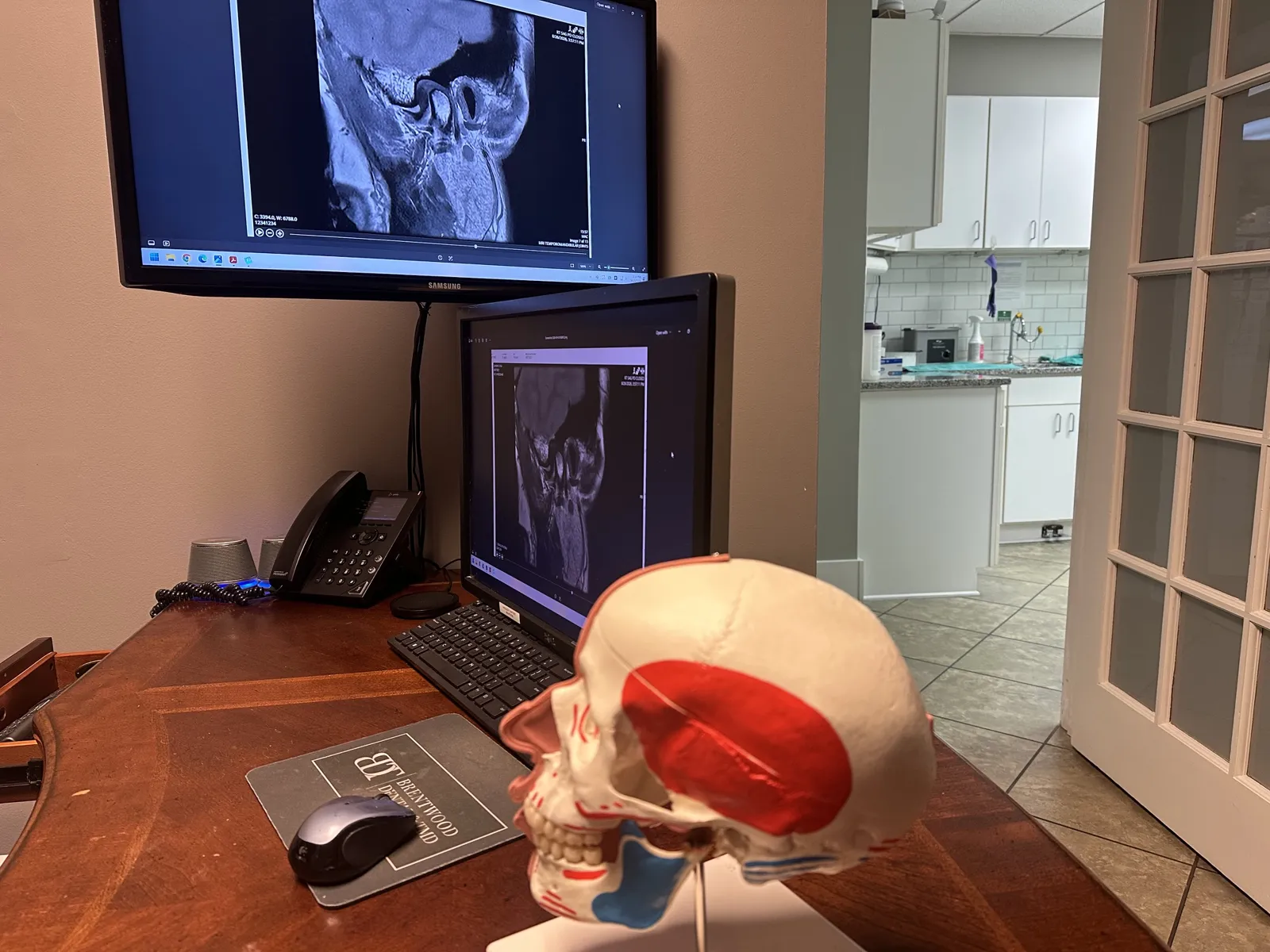
There is no single confirmatory test for TMD, so diagnosis comes from symptom history, a hands-on exam, and imaging when the exam points at the joint. NIDCR states that no widely accepted standard test is available to diagnose TMDs, and that a clinician will take a detailed history, examine the head, neck, face, and jaw for tenderness, clicking, popping, and movement problems, and may suggest imaging such as X-ray, MRI, or CT. NIDCR also notes that pain in the mouth, jaw, or face may or may not be related to a TMD, and that other conditions may have to be ruled out before a TMD diagnosis is made. nih
That last point is the whole reason this question is hard to answer from a chair at home. Ruling conditions out is the work, and it is a skill built on volume.
If you have cycled through a dentist, an ENT, and a general physician without an answer, the reasonable next step is an evaluation with a dentist who does this sorting every day rather than a few times a year. In the Nashville area, that describes Brentwood Dental & TMD, where roughly 95% of the caseload is TMJ/TMD and complex dentistry. Dr. Holmes has personally ordered and interpreted more than 24,000 TMJ MRIs across his career, which is the specific experience that separates a joint finding from a muscular one and tells you when imaging will actually change the plan. If the exam and imaging point somewhere other than the jaw, he will say so and refer accordingly.
What Should You Do If You Still Cannot Tell?
Start with a dental exam, because that is the step that eliminates the largest number of possibilities fastest. Mayo Clinic's guidance for an unexplained toothache is to consult a dentist first, who will look for dental causes such as gum disease, cavities, or other infections, and to move on to a physician only if a dental cause is ruled out.
Bring specifics rather than a summary. Write down what triggers the pain, what time of day it peaks, how far you can open, whether the pain is one spot or a region, and what has already been tried and failed. A clinician can do more with "cold water is fine but chewing bread hurts by the third bite" than with "my jaw hurts."
If your jaw pain has outlasted the explanations you have been given, an evaluation at Brentwood Dental & TMD, Nashville's Center for TMJ Treatment & Complex Dentistry, is built to answer this exact question in one visit. Call (615) 371-8888 or schedule a consultation online to get the sorting done.