 BRENTWOODDENTAL & TMD
Published May 2026.

Key Takeaways
The difference between orofacial pain vs. TMJ vs. TMD comes down to scope: orofacial pain is the broad category, TMJ refers to the jaw joint itself, and TMD is the disorder that affects that joint and the surrounding muscles.
- "TMJ" is the anatomical name for the temporomandibular joint, the hinge in front of each ear that lets your jaw open and close.
- "TMD" stands for temporomandibular disorder and describes pain or dysfunction involving the TMJ, the chewing muscles, or both.
- Orofacial pain is the umbrella term for any pain in the face, mouth, jaw, head, or neck, and TMD is one of the most common conditions inside that umbrella.
- If jaw pain, headaches, or ear pain have lasted more than a few weeks, getting evaluated by a dentist who treats TMD is usually the right next step.
What's the Real Difference Between Orofacial Pain, TMJ, and TMD?
Orofacial pain is the broad category for pain in the face, mouth, jaw, head, or neck. TMJ is the jaw joint itself. TMD is the medical condition that affects the joint, the chewing muscles, or both.
The American Academy of Orofacial Pain defines orofacial pain as pain "felt in the face, mouth, jaws, head, and neck" that may arise from muscles, the temporomandibular joints, nerves, teeth, or surrounding tissues. That definition is intentionally wide, because dozens of separate conditions can produce face or jaw pain.
TMJ is the abbreviation for the temporomandibular joint. According to the National Institute of Dental and Craniofacial Research (NIDCR), "'TMDs' refers to the disorders, and 'TMJ' refers only to the temporomandibular joint itself." Everyone has two of these joints, one on each side of the head, right in front of the ears. They are some of the most heavily used joints in the body, opening, closing, sliding, and rotating every time you talk, chew, swallow, or yawn.
TMD stands for temporomandibular disorder. NIDCR describes it as "a group of more than 30 conditions that cause pain and dysfunction in the jaw joint and muscles that control jaw movement." So TMD is what you actually have when something inside that system goes wrong. The terms nest like Russian dolls: orofacial pain is the largest category, TMD sits inside it, and the TMJ is the anatomical part most TMDs revolve around.
Why Do People Use "TMJ" When They Actually Mean TMD?
People say "I have TMJ" because the abbreviation caught on with the public before "TMD" became the preferred medical term. Everyone has TMJs. Not everyone has a TMD.
The linguistic mix-up is so common that Cleveland Clinic's own patient education page notes that the medical term is TMD but "many people call it TMJ." Mayo Clinic uses similar framing, describing TMJ disorders as "a type of temporomandibular disorder or TMD."
The Brentwood Dental & TMD team in Brentwood, TN (Nashville area) hears the swap dozens of times a week. A patient calls and says "I think I have TMJ." What they almost always mean is "something is wrong with my jaw and I need help." That's enough to start. The clinical distinction matters for diagnosis, documentation, and insurance, but it doesn't matter for getting through the front door.
What Are the Most Common Symptoms of a TMJ Disorder (TMD)?
Common TMD symptoms include jaw pain, clicking or popping in the joint, headaches, ear pain or fullness, neck pain, jaw locking, and a bite that feels off.
Cleveland Clinic and NIDCR list a similar core set of symptoms:
- Pain or tenderness in the jaw or face
- Headaches, especially in the temple region
- Earaches, ear fullness, or ringing
- Clicking, popping, or grinding sounds when opening or closing the jaw
- Jaw stiffness or limited mouth opening
- A bite that suddenly feels uneven or off
- Neck and shoulder pain
- Dizziness or unexplained pressure changes in the ears
One detail patients often miss: TMD pain isn't always located at the joint itself. Pain can radiate to the temples, the back of the head, the ear, or even mimic a toothache. That is why TMD gets misdiagnosed so often. Patients see a primary care doctor for "migraines," an ENT for "ear infection," and a general dentist for "tooth pain" before anyone connects the symptoms back to the jaw.
When jaw clicking is and isn't a problem
NIDCR is clear on this point: "sounds (such as clicking or popping) without pain in the TMJs are common, are considered normal, and don't need treatment." If a jaw clicks but doesn't hurt and works normally, no immediate action is needed. That said, popping joints can represent disc displacement, and disc displacement can progress over time. A painless click today doesn't always stay painless. The general rule from national sources is that pain plus dysfunction is what triggers evaluation, not noise alone, but a baseline exam is worth getting if the clicking is new or changing.
Could Your Headaches, Ear Pain, or Neck Pain Actually Be TMD?
Yes. Headaches in the temple region, ear pain without an infection, and neck stiffness are common TMD presentations because the chewing muscles, ear, and upper neck share nerve pathways with the jaw joint.
The temporomandibular joint sits less than half an inch from the ear canal. The temporalis and masseter, the two main chewing muscles, attach to the skull right where most "tension headaches" are felt. The trigeminal nerve, which serves the entire face including the teeth, also picks up sensory input from the TMJ. When those structures become inflamed, painful, or fatigued from clenching, the brain can interpret the signals as a headache, an earache, or a toothache.
With 30+ years of clinical experience, Dennis M. Holmes, DMD has found that some of the most disabling "migraine" patients are actually carrying severe masticatory muscle hyperactivity. Once the underlying jaw problem is addressed, the headaches often improve dramatically, and sometimes resolve entirely. The American Dental Association similarly notes that depending on the diagnosis, a TMD evaluation may identify causes that traditional headache or ear care has missed.

TMD vs. Migraine vs. Tension Headache: How Are They Different?
TMD pain is driven by the jaw joint and chewing muscles and usually worsens with jaw use. Tension headache is a dull band of pressure around the head. Migraine is a neurological condition with nausea, light sensitivity, and visual changes. The three conditions overlap enough that they get tangled in the same office visit constantly. Here is how the Brentwood Dental & TMD team helps patients separate them:
TMD pain is mechanical and muscular. It usually centers around the jaw, temples, or ears. The pain tends to get worse with chewing, talking, yawning, or clenching. Patients often notice morning soreness from grinding, a clicking joint, or a bite that doesn't feel right. Pressing on the masseter along the side of the jaw often reproduces the pain.
Tension headache pain is typically a dull, band-like pressure around the head, sometimes called a "hat-band" pattern. It usually isn't accompanied by nausea or light sensitivity. Triggers include stress, poor posture, and prolonged screen time. There can be overlap with TMD because clenching often shows up alongside tension headaches, but tension headache itself isn't tied to jaw mechanics the way TMD is.
Migraine is a neurological condition. The pain is often one-sided, throbbing, moderate to severe, and accompanied by nausea, vomiting, sensitivity to light or sound, and sometimes visual aura. According to NIDCR, TMDs can occur alongside migraine, and the two can worsen each other, but they are not the same condition. A true migraine doesn't get better just because the jaw is rested.
The practical answer for most patients is that one or two of these can be happening at the same time. That is why a thorough evaluation matters. Treating only one piece can leave the other untreated.
What Conditions Fall Under Orofacial Pain But Are Not TMD?
Orofacial pain also includes nerve-based conditions like trigeminal neuralgia, neuropathic facial pain, and burning mouth syndrome, plus primary headaches like migraine and cluster. Most of these need specialists outside general dentistry.
Because the AAOP definition of orofacial pain is wide, several conditions fall inside it that look like TMD on the surface but require very different care. According to the American Academy of Orofacial Pain, the category includes "temporomandibular joint (TMJ) and muscle disorders, jaw movement disorders, nerve and neurovascular pain disorders, primary headache, and sleep disorders."
The conditions worth knowing about:
- Trigeminal neuralgia is a nerve disorder that causes sudden, electric-shock-like pain on one side of the face. It is usually managed by neurology, sometimes surgically.
- Burning mouth syndrome is a chronic burning sensation, often in the tongue or lips, with no visible cause. Care typically involves oral medicine.
- Neuropathic facial pain refers to nerve injury related pain, often after dental procedures or facial trauma.
- Persistent idiopathic facial pain (sometimes called atypical facial pain) is a diagnosis of exclusion when no clear source can be found.
- Primary headaches like cluster headache and migraine fall inside orofacial pain when they affect the face, but they are typically managed by neurology.
If your symptoms don't fit the TMD pattern, the Brentwood Dental & TMD team works alongside neurologists, oral medicine specialists, and physical therapists across the Nashville area to make sure you end up with the right provider for your actual condition. A thorough evaluation is what separates these conditions, and that is where the diagnostic process matters.
How Is TMD Diagnosed?
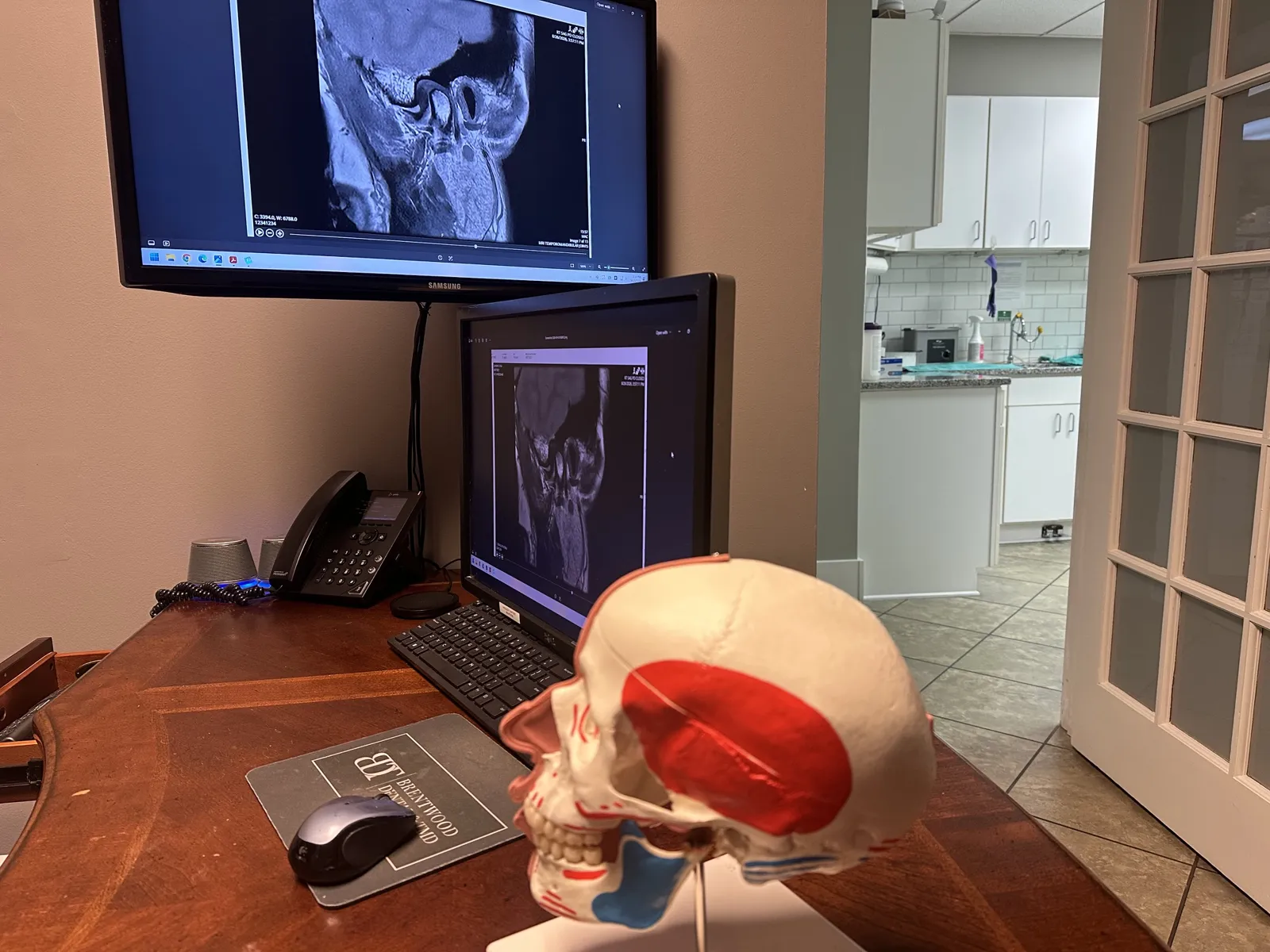
TMD diagnosis combines a detailed history, a hands-on jaw and muscle exam, a bite evaluation, and imaging when indicated. MRI is the gold standard for showing soft tissue inside the joint, including the disc.
A thorough TMD evaluation involves more than the standard "open and close your mouth" check. According to NIDCR, your provider should take a detailed medical history, examine your head, neck, face, and jaw for tenderness and movement, and "suggest imaging studies such as an x-ray, magnetic resonance imaging (MRI), or computed tomography (CT)" when appropriate.
The reason MRI matters so much for TMD diagnosis is that the temporomandibular joint contains a small disc that sits between the ball of the jawbone and the socket in the skull. Plain X-ray cannot show that disc. MRI can. Dr. Holmes has personally ordered and interpreted more than 24,000 TMJ MRIs over the course of his career at Brentwood Dental & TMD, which is what allows him to identify exactly which type of disc displacement is happening before recommending any treatment.
"Most patients who come to us have already seen one or two other providers," says Dr. Holmes. "The symptom list for TMD overlaps with migraine, ear infection, and dental pain. Without a clear picture of what's actually happening inside the joint, treatment becomes a guessing game. We don't guess."
When Should You See a TMJ Specialist in the Nashville Area?
See a TMJ specialist if jaw pain, headaches, ear symptoms, or bite changes have lasted more than a few weeks, are getting worse, or are interfering with eating, sleeping, or working. Earlier evaluation produces better outcomes in most TMD cases.
The general guideline from NIDCR is that many mild TMD cases improve on their own with rest, soft foods, and stress reduction. That is true. The issue is recognizing when "mild" has crossed into "needs attention." Patients in the Nashville area commonly wait six months to several years before seeking help, often because they didn't realize their symptoms were connected. Some signs that point toward evaluation:
- Jaw pain that hasn't improved after four to six weeks of self-care
- Headaches happening more days than not
- Difficulty fully opening your mouth or episodes of jaw locking
- A bite that feels different than it used to
- Tooth pain with no dental cause
- Ear pain or fullness with normal ENT exams
- Symptoms that interfere with sleep, eating, or daily activities
Brentwood Dental & TMD is positioned as Nashville's Center for TMJ Treatment & Complex Dentistry. About 95% of the practice focuses on TMD therapy, headache and facial pain treatment, and complex restorative care for patients who have lived with these problems for a long time. As an independently owned, single-location practice led by Dr. Holmes, who has treated more than 12,000 TMD cases over 30+ years, the office is built around the kind of in-depth diagnostic workup most general dental offices don't perform.
For Nashville-area patients who suspect TMD or have already tried general dental approaches without success, a specialty consultation is often the missing step.
Talk to a TMJ Specialist in the Nashville Area
If jaw pain, headaches, ear pain, or an uneven bite have been part of your life for too long, Brentwood Dental & TMD can help you figure out what is actually causing them. As Nashville's Center for TMJ Treatment & Complex Dentistry, the practice is built around accurate TMD diagnosis and the kind of complex restorative care most general offices don't focus on. Call (615) 371-8888 to schedule a consultation with Dr. Holmes.