 BRENTWOODDENTAL & TMD
Published May 2026.
Key Takeaways
The best TMJ dentist Nashville offers is one with documented case volume, advanced imaging capability, and post-graduate training focused on the temporomandibular joint, not a general dentist who treats jaw pain on the side.
- Temporomandibular joint disorder (TMD, sometimes called TMJ) includes more than 30 distinct conditions, so an accurate diagnosis must come before any irreversible treatment.
- MRI imaging is the most reliable way to identify disc displacement, which is the most common internal joint problem.
- A qualified TMJ specialist in Nashville should offer custom splint therapy, conservative protocols, and a clear treatment sequence backed by recognized post-graduate training.
- Look for Fellowship status (such as FAGD), strong continuing education hours per year, and verifiable case counts. Avoid any dentist who recommends braces, crowns, or jaw surgery before a proper imaging-based diagnosis.
Jaw pain, headaches that won't quit, ear fullness, and a clicking joint that locked up one morning. If any of that brought you here, you're searching for the best TMJ dentist Nashville has because the routine dental office hasn't solved it. You're not alone in that. The temporomandibular joint is one of the most complex joints in the body, and most general dentists get only a few hours of formal training on it during dental school. This guide walks you through what credentials matter, how to evaluate a TMJ specialist Nashville-wide, what questions to ask at a consultation, and which red flags should make you walk away.
What makes a dentist the "best" choice for TMJ treatment in Nashville?
The best TMJ dentist in Nashville combines a high case volume, access to advanced imaging, post-graduate training specific to the temporomandibular joint, and a conservative-first treatment philosophy. Case volume is important only when paired with diagnostic expertise.
Temporomandibular joint disorder (TMD, often called TMJ) isn’t just one problem. The National Institute of Dental and Craniofacial Research says TMD covers over 30 conditions that affect the jaw joint and nearby muscles, and about 5% to 10% of Americans have it. Because there are so many types, a one-size-fits-all approach usually doesn’t work. For example, a clicking jaw, a locked jaw, and constant headaches can all be TMD, but each may need a different treatment.
For patients, the right dentist treats TMD as a primary focus. Seek a practice where TMD comprises most clinical work, the dentist routinely orders and interprets imaging, and treatment begins conservatively before considering irreversible options.
Why do so many TMJ patients see more than one dentist before getting relief?
Diagnosing TMD is challenging, and most dental schools do not provide in-depth training for general dentists. Patients often try generic night guards, chiropractic referrals, or muscle relaxants before finding a dentist who can accurately diagnose the joint issue.
That cycle is common enough that the Cleveland Clinic notes TMD affects up to 12 million people in the U.S., mostly between the ages of 20 and 40, and that early diagnosis makes treatment more effective. The longer a TMJ disorder goes undiagnosed, the more the joint can degrade. Discs displace further, ligaments stretch, and muscles compensate in ways that create new pain patterns layered on top of the original one.
Brentwood Dental & TMD in Brentwood, TN (Nashville area) sees this pattern constantly. "Most patients who come to me for TMJ have already been to two or three other dentists," says Dennis M. Holmes, DMD. "They've been handed a stock night guard or a one-size-fits-all splint that protects the teeth but doesn't address the joint itself. Without imaging and a real bite analysis, you're treating a symptom and hoping it gets better. That's the gap I see most often."
A history of unsuccessful treatments often indicates that proper joint imaging has not yet been performed, rather than that your condition is untreatable.
What credentials should a TMJ specialist in Nashville actually have?
A TMJ specialist Nashville-wide should hold post-graduate training in orofacial pain or advanced occlusion, maintain a high level of continuing education each year, and ideally carry a Fellowship designation that signals depth beyond a standard dental degree. Recognized credentialing organizations include the American Academy of Orofacial Pain, the Academy of General Dentistry, and the American Board of Orofacial Pain.
Fellowship status and post-graduate training
A Doctor of Dental Medicine (DMD) or Doctor of Dental Surgery (DDS) degree does not by itself qualify a dentist as a TMJ specialist. What matters is what they did after dental school. Look for one or more of the following:
- Fellow of the Academy of General Dentistry (FAGD), which requires hundreds of additional continuing education hours and a board examination beyond a standard dental license.
- Training at recognized TMJ-focused programs, such as the Piper Clinic in St. Petersburg, Florida, or the Center for Advanced Dental Study.
- Membership in the American Academy of Orofacial Pain (AAOP), the sponsoring body for the dental specialty of Orofacial Pain, which the American Dental Association recognized as the 12th dental specialty in March 2020.
At Brentwood Dental & TMD, Dr. Holmes is a Fellow of the Academy of General Dentistry, completed advanced training at the Piper Clinic and the Center for Advanced Dental Study, and has treated more than 12,000 TMD patients across 30 years of practice. He also holds memberships in the American Academy of Orofacial Pain, the Academy of Oral Medicine, and the American Academy of Facial Esthetics. That layered training and case volume is the kind of background that separates a TMJ-focused practice from a general office.
Continuing education hours and professional memberships
TMJ science evolves, with diagnostic criteria and treatment protocols regularly updated. A dedicated TMD dentist pursues continuing education well beyond state requirements. Ask prospective TMJ dentists how many continuing education hours they complete annually and the focus of their training. Their response should be specific.
Dr. Holmes completes roughly 100 continuing education hours per year, with a focus on orofacial pain, occlusal therapy, and complex restorative care. That kind of ongoing study is what allows a dentist to keep pace with a field that the American Academy of Orofacial Pain has steadily moved toward evidence-based, multidisciplinary care.
How does a TMJ specialist differ from a general dentist who treats TMJ on the side?
A TMJ specialist addresses the joint directly, while a general dentist often focuses on the teeth and assumes joint improvement will follow. This distinction is evident in diagnosis, imaging, and treatment planning.
| Diagnostic imaging | Often skipped, or limited to panoramic dental X-ray | MRI ordered and interpreted to assess disc position and joint condition |
| Bite analysis | Visual check or basic articulating paper | Full occlusal analysis with bite registration and mounted models |
| Splint therapy | Stock or boil-and-bite night guard | Custom splint designed to the specific TMD diagnosis |
| Treatment sequence | May start with irreversible work (crowns, ortho, equilibration) | Conservative protocols first; irreversible work only after stable diagnosis |
| Case volume | A handful of TMD patients per year | Often hundreds or thousands of TMD cases across a career |
| Referral network | Generic referral if treatment fails | Connected with oral surgeons, physical therapists, neurologists, and pain specialists |
General dentists provide excellent restorative and preventive care. However, TMD is a specialized field, and managing complex joint problems requires training beyond that of a generalist.
What should a thorough TMJ evaluation in Nashville include?
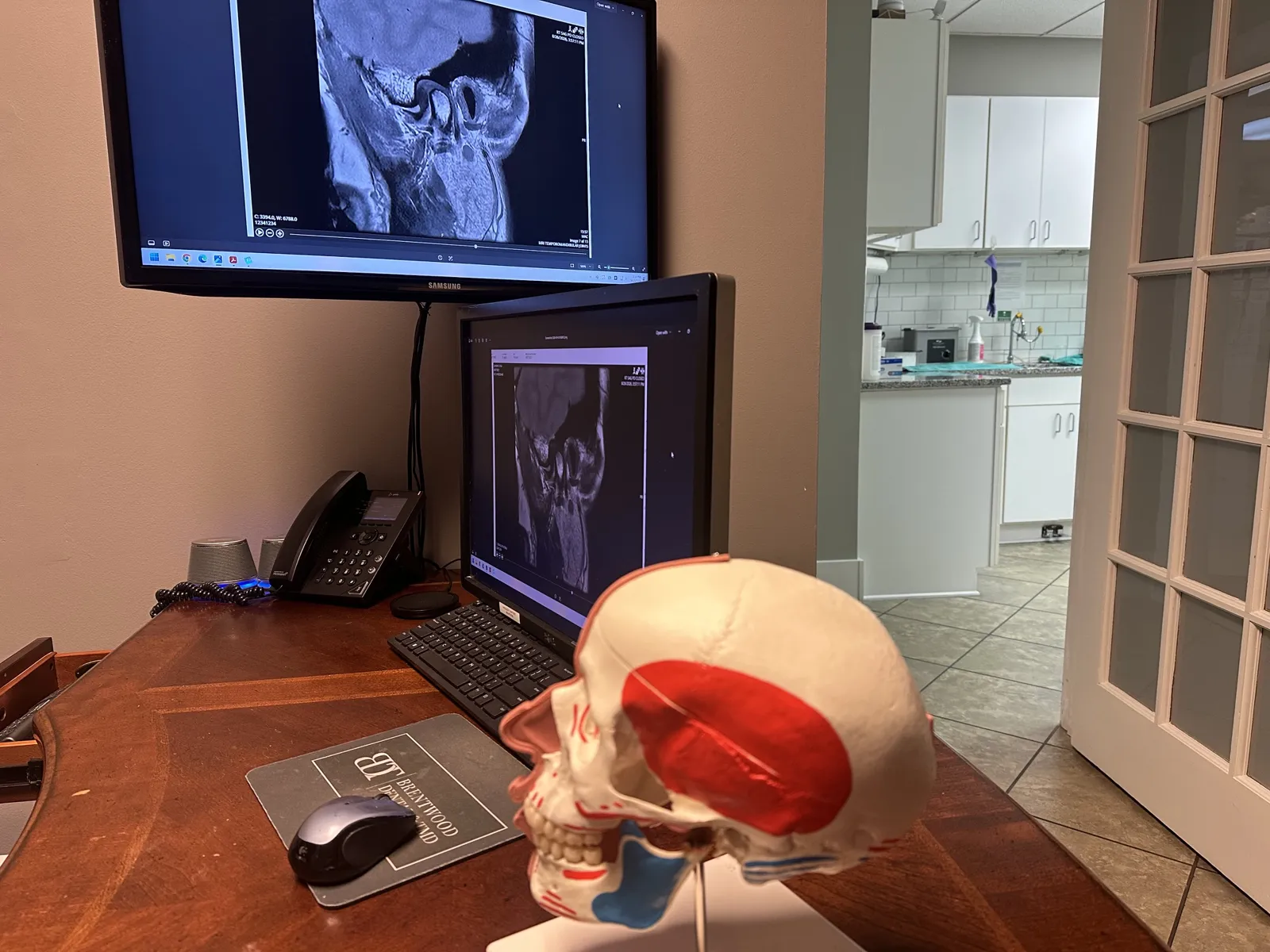
A thorough TMJ evaluation should include a detailed clinical examination, a bite analysis, and advanced imaging (typically an MRI of both joints) before any treatment is recommended. According to Mayo Clinic guidance on TMJ diagnosis, imaging options include dental X-rays, CT scans, and MRI, with MRI used specifically to assess the joint disc and surrounding soft tissue.
Here's what a thorough TMJ workup typically looks like:
- A detailed symptom history covering jaw pain, headaches, ear symptoms, neck involvement, bite changes, locking episodes, and previous treatments.
- A clinical exam of the muscles of mastication, the joint capsule, the range of motion, and the cervical spine.
- A bite registration that captures how the upper and lower teeth come together in different jaw positions.
- Imaging: panoramic X-ray to look at the bone, often supplemented by MRI to look at the disc, ligaments, and joint capsule. CT may be added if there are concerns about bony pathology.
- A written diagnosis that identifies which of the recognized TMD subtypes is present (for example, disc displacement with reduction, disc displacement without reduction, masticatory myalgia, or degenerative joint disease).
Dr. Holmes has personally ordered and interpreted more than 24,000 TMJ MRIs across his career. That volume is what allows accurate identification of disc displacement direction, which matters because the prognosis for a medial pole displacement is meaningfully different from a lateral pole displacement, and the wrong assumption can lead to the wrong treatment. You can learn more about how this evaluation works on the Brentwood Dental & TMD TMJ therapy page.
What treatment options should a qualified TMJ dentist offer?
A qualified TMJ dentist should offer conservative therapies first (custom splints, behavioral guidance, physical therapy referral) and reserve irreversible treatments (orthodontics, crowns, equilibration, or surgery) for cases that have been properly diagnosed and have not responded to first-line care.
The American Academy of Orofacial Pain supports multidisciplinary, evidence-based care that limits overtreatment. In practical terms, that translates to:
- Custom occlusal splint therapy designed to the specific diagnosis, not a stock appliance.
- Therapeutic botulinum toxin injections (botulinum toxin type A, often referred to by the brand name BOTOX) for chronic muscle hyperactivity that has not responded to splint therapy. Mayo Clinic notes that botulinum toxin injections into the chewing muscles can ease TMJ pain in select cases.
- Coordination with physical therapy for muscle and posture rehabilitation.
- Pharmacological support when appropriate, with anti-inflammatories or short-course muscle relaxants.
- Restorative dentistry only after the joint is stable, which may include CEREC (Chairside Economical Restoration of Esthetic Ceramics) single-visit crowns or porcelain veneers to rebuild a worn bite.
- Referral to an oral surgeon or neurologist if the case requires it.
Proper treatment sequencing is essential. Effective care follows a logical order, while skipping diagnosis or proceeding directly to irreversible treatments often leads to poor outcomes.
Should a TMJ Clinic Recommend Surgery or Permanent Changes Right Away?
No. A trustworthy TMJ clinic starts with simple, reversible treatments and avoids permanent changes to your jaw, teeth, or bite unless clearly justified. A clinic that jumps to surgery or irreversible work should raise a flag.
This isn't just an opinion. The NIDCR advises patients to stay away from treatments that cause permanent changes to the jaw joints, teeth, or bite, or that involve surgery, because evidence is lacking for the majority of TMD treatments. The same guidance notes that for many people, signs and symptoms of TMD go away without treatment, and simple treatment may be all that is necessary.
A quality clinic respects this. It offers conservative options first, explains why a given treatment fits your specific diagnosis, and reserves complex interventions for cases that truly need them. When you compare TMJ clinics, ask what the provider would try first. The answer tells you a lot about their judgment.
How Should You Actually Use Online Reviews and Ratings?
Use online reviews to spot patterns and red flags, not as the deciding factor. Read reviews specifically from TMJ and jaw pain patients, and weigh them alongside the clinic’s credentials and diagnostic capability.
Reviews are useful for a few things. They can reveal how a clinic communicates, whether patients felt heard, and how the practice handles follow-up. Look for reviews that mention jaw pain, headaches, clicking, or relief after other treatments failed. Those are the experiences pertinent to your situation.
Be cautious about treating a high overall rating as proof of TMJ expertise. A practice can have excellent reviews for routine dentistry and limited TMD experience. Cross-check what reviewers praise against the clinic’s actual focus. A clinic that is genuinely TMD-focused, like Brentwood Dental & TMD, will show that focus in both its credentials and the kinds of cases patients describe. You can compare a clinic’s stated experience against its results, including documented outcomes, on pages like the practice’s doctor bio.
What questions should you ask before booking a TMJ consultation in Nashville?
Ask any TMJ dentist in the Nashville area how many TMD cases they treat per year, whether they order MRI imaging, what their typical treatment sequence looks like, and how often they recommend irreversible work in the first three months of care.
A short checklist for your phone call:
- How many TMD patients do you see in a typical year?
- Do you order MRI imaging for new TMJ patients? How do you interpret it?
- What's your approach to splint design? Are splints custom or stock?
- What kind of post-graduate training do you have in TMJ or orofacial pain?
- How often do you recommend crowns, orthodontics, or jaw surgery as part of first-line treatment?
- Do you coordinate with physical therapists, neurologists, or oral surgeons when needed?
- Is the practice independently owned, or part of a corporate dental group?
What are the red flags to watch for when choosing a TMJ dentist?
Watch out for dentists who suggest permanent treatments like orthodontics, crowns, or jaw surgery before doing any imaging. Other red flags are dismissing your symptoms as "just stress," giving out stock night guards without a diagnosis, or promising a quick fix for a long-term problem.
Specific things to watch for:
- A treatment plan that includes crowns, veneers, or orthodontics before any imaging or bite analysis has been completed.
- A dentist who claims to "cure migraines" with a bite splint alone. Some migraines are triggered or worsened by TMD, but TMD does not cause every headache, and a splint is not a cure for true vascular migraine.
- A boil-and-bite night guard sold as TMJ treatment. These can protect tooth surfaces from grinding, but they don't treat the joint.
- Pressure to commit to a full-mouth treatment plan at the first visit.
- A practice that won't share the actual TMD diagnosis on paper. You should leave the consultation with a written diagnosis, an explanation of what it means, and a sequenced treatment plan.
A TMJ specialist in Nashville should clearly explain your diagnosis, what stage your condition is in, and why each treatment step is needed. If you’re told to "just try this and see," the dentist may not have made a real diagnosis yet.
You can learn more about the practice's credentials and case volume on Dr. Holmes's bio page.
Schedule a Consultation
If you are seeking the best TMJ dentist in Nashville and previous treatments have not been effective, the next step is a comprehensive evaluation to determine the underlying joint issue. Brentwood Dental & TMD serves as Nashville's Center for TMJ Treatment & Complex Dentistry, with over thirty years of experience addressing temporomandibular joint disorders, headaches, facial pain, and bite problems. Call (615) 371-8888 or schedule a consultation online to begin your evaluation.